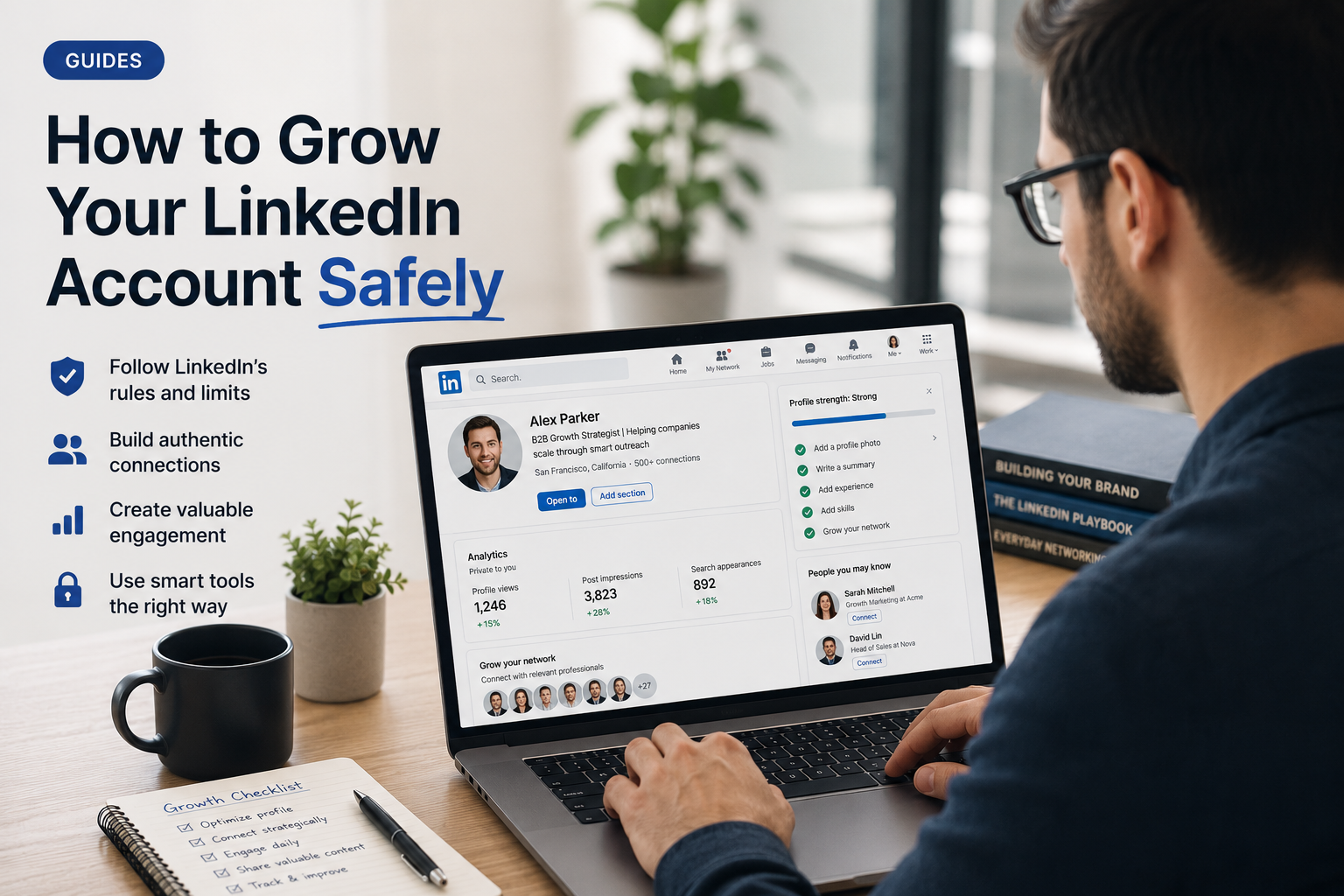
How to Grow Your LinkedIn Account Safely
Growing a LinkedIn account is the compounding result of three things done consistently: connecting with the right people, staying inside LinkedIn's activity limits, and following up without manual effort — Outflo is built to handle all three without putting the account at risk.
Most guides on "LinkedIn growth" talk about content strategy — post more, comment more, build a personal brand. That's real, but it's slow and it's not what most sales teams, agencies, and founders actually mean when they say they want to grow a LinkedIn account. What they mean is: more relevant connections, more conversations, more pipeline, without the account getting restricted along the way. This guide covers that version of growth — the outreach-and-network side — and where Outflo fits into each step.
What "LinkedIn account growth" actually means and when it matters
There are two different growth problems on LinkedIn, and conflating them is where most advice goes wrong.
The first is audience growth — followers, post reach, personal brand. That's a content and engagement problem, and Outflo doesn't touch it. If a "grow LinkedIn" search brought you here looking for a posting calendar, this isn't that guide.
The second is network and pipeline growth — expanding a LinkedIn account's connections deliberately, toward people who match a real target profile, and turning a meaningful share of those connections into conversations. This is a sales and outreach problem, and it's the one Outflo is built for.
This matters most for three groups: agencies running outreach for multiple clients, B2B sales and GTM teams trying to fill a pipeline without hiring more SDRs, and founders doing their own outbound before they have a sales team. In every case, the constraint isn't ideas — it's execution capacity. A person can only send so many personalized connection requests and follow-ups by hand in a day before either quality drops or the account gets flagged for suspicious activity. That second risk is the one that should shape how growth actually gets executed, not just how fast it happens.
The workflow: how to grow a LinkedIn account step by step with Outflo
Define the audience before sending a single request
Growth without targeting is just noise, and noise is what gets accounts reported. Before anything goes out, the target list should be built from a real filter — job title, industry, company size, geography — not a vague "decision makers" list. Outflo doesn't build lead lists from scratch; it connects to how leads already get sourced, importing lists from LinkedIn search results, CSV uploads, or tools like Apollo and Clay through its integrations. The growth engine only works as well as the list it's fed.
Build the outreach as a sequence, not a single message
A single connection request with no follow-up is the single biggest reason LinkedIn growth stalls. Most accepted connections never reply to the first message — they need a second touch, sometimes a third, spaced out realistically. Outflo's Smart Sequences handle this as branching logic rather than a fixed timeline: the sequence checks whether the request was accepted, whether the person replied, whether their profile is even open to messaging, and routes each lead down a different path based on the answer. A connection who accepts and replies gets pulled out of the sequence into the inbox. One who accepts but goes quiet gets a follow-up on a set delay. One who never accepts gets a different next step entirely — instead of every lead being pushed through the exact same script regardless of what actually happened.
Personalize at scale instead of choosing between "personal" and "scale"
Generic templates get lower acceptance and reply rates, but writing every message by hand doesn't scale past a handful of leads a day. Outflo's AI Personalization drafts messages using a prospect's actual recent LinkedIn activity rather than a static "Hi {firstName}" template with the name swapped in. It supports variable syntax for merge fields, and — critically for growth at volume — a configurable fallback behavior for when data is missing: skip the lead, send a blank/generic version, or use a fallback value. That last part matters more than it sounds. A sequence that breaks or sends "Hi ," to half its leads because of missing data does more damage to an account's reputation than it saves in time.
Protect the account while scaling activity
This is the step most growth advice skips entirely, and it's the one that determines whether growth is sustainable or short-lived. LinkedIn watches for patterns that look automated: identical timing between actions, requests going out faster than a human plausibly could send them, and — for anyone running several accounts — multiple accounts behaving in obvious sync from the same location. Outflo's multi-account infrastructure gives each connected account a dedicated residential IP and independent pacing, so activity on one account doesn't create a fingerprint that ties it to others, and volume is spread out rather than fired in bursts.
Read the results and route replies into one place
Growth isn't just requests going out — it's conversations coming back, and those need to land somewhere manageable. Outflo's Unified Smart Inbox centralizes replies across every connected account into one view, so a team running outreach from five or ten profiles isn't checking five or ten separate LinkedIn inboxes to find who responded. Analytics sit alongside it — acceptance rate, reply rate, and step-by-step funnel data per sequence — so it's visible which part of the sequence is actually converting and which part is quietly losing people.
Common failure modes and how to avoid them
Treating connection requests as the whole strategy. A high acceptance rate with no follow-up sequence behind it is a wasted opportunity — most replies come from the second or third touch, not the first. Build the sequence before sending the first request, not after seeing how the first batch performs.
Scaling activity faster than the account's history supports. A newer or recently-quiet account jumping straight to high daily volume is one of the fastest ways to trigger a restriction. Ramp activity gradually and let pacing settings do the work rather than manually pushing volume up week over week.
Running multiple accounts without isolating them. Several team-managed accounts sending near-identical messages, on a similar schedule, from the same network, is a recognizable pattern — to LinkedIn and, eventually, to the leads themselves. Independent pacing and IP isolation exist specifically to prevent this, and skipping that setup to save time is the single most common way agencies put an entire pool of accounts at risk over one careless one.
Letting personalization fail silently. A sequence with no fallback plan for missing data (no recent activity to reference, no company field filled in) will send broken or generic messages to a chunk of the list without anyone noticing until reply rates drop. Set the fallback behavior deliberately rather than leaving it on a default.
Never looking at the funnel data. Growth that isn't measured can't be improved. A sequence with a strong acceptance rate but a weak reply rate has a message problem, not a targeting problem — and a sequence with a weak acceptance rate has the opposite issue. Without per-step analytics, it's a guess which one it is.
A practical Outflo example
Take an agency running outreach for a client selling to marketing directors at mid-size SaaS companies. The list of ~2,000 marketing directors comes in from a Sales Navigator search, imported into Outflo as a lead list. A Smart Sequence is built with three branches: connection request with a personalized opener referencing the prospect's recent activity, a follow-up three days later if there's no reply, and a different, shorter follow-up a week after that for anyone whose profile shows as open to messaging but who never responded to the first two.
The sequence runs across four connected LinkedIn accounts on the client's team, each with its own IP and independent pacing, so no single account is sending 200 requests a day on its own. Replies land in the Unified Smart Inbox, tagged by which account and sequence they came from. At the end of the first two weeks, the analytics show a solid acceptance rate but a reply rate lower than expected on the second follow-up step specifically — a signal to rewrite that one message rather than the whole sequence, because everything before it is already working.
What Outflo doesn't do in this scenario: it doesn't build the target list from scratch (that's Sales Navigator or an enrichment tool feeding in through the integration), and it doesn't run email or paid ad components of the same campaign — those sit in whatever the team's email or ad tool of choice is. Outflo is the LinkedIn execution layer, not the entire GTM stack.
Checklist and next steps
Before scaling LinkedIn outreach with Outflo, confirm:
- The target list is filtered against a real ICP, not a broad title search
- The outreach is a multi-step sequence with branching logic, not a single message
- Personalization has a defined fallback for missing data, not a silent default
- Every connected account has independent pacing and its own IP, especially with more than one account running
- Acceptance rate, reply rate, and step-level funnel data are being checked weekly, not just at campaign end
- Daily activity volume matches the account's age and history, and ramps up gradually rather than jumping
Growth on LinkedIn isn't about doing more — it's about doing the same disciplined outreach motion consistently, at a volume the account can actually sustain, with the follow-through that a single person sending requests by hand can't keep up. That's the specific gap Outflo is built to close.
FAQ
Common questions
How many LinkedIn connection requests can I send per day without getting restricted?
There's no single safe number — it depends on the account's age, history, and how gradually activity ramps up. A brand-new or recently-dormant account should start well below what an established, active account can sustain, and increase slowly rather than jumping straight to a target volume.
Do I need multiple LinkedIn accounts to grow my network faster?
Not necessarily. A single well-run account with a solid follow-up sequence and consistent, sustainable pacing can grow steadily on its own. Multiple accounts help when the target list is large enough that one account's safe daily volume can't cover it in a reasonable time — agencies running outreach for several clients are the most common case.
Can LinkedIn automation get my account banned or restricted?
Automation itself isn't the risk — the pattern it creates is. Requests sent at inhuman, identical intervals, volume that jumps overnight, or multiple accounts behaving in obvious sync are what get flagged. Randomized pacing, gradual ramp-up, and per-account isolation are what keep automated outreach looking like normal account activity.
What's the difference between growing LinkedIn followers and growing LinkedIn connections?
Follower and content growth build an audience for organic posts and are driven by posting and engagement. Connection growth builds a targeted network for direct outreach and pipeline, driven by sequences and personalized messaging. They can support each other, but they're solved with different tools and different effort.
Should I combine LinkedIn content posting with outreach automation?
Yes — they're not competing approaches. A strong content presence can improve reply rates on outreach because prospects recognize the name before the message lands, and outreach can put content in front of people who'd never see it organically. A tool like Outflo covers the outreach side; content strategy is a separate, complementary effort.