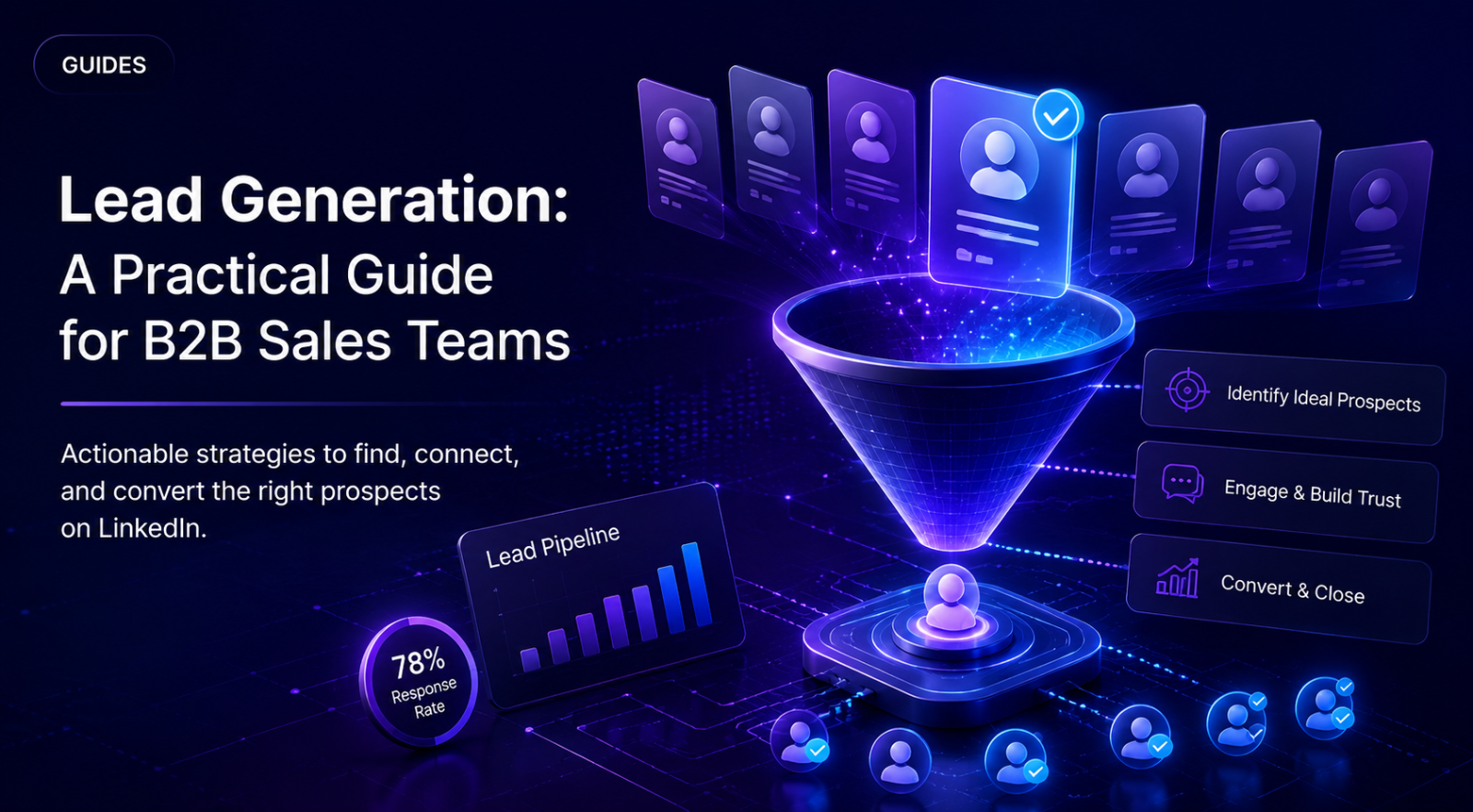
Lead generation is the process of identifying people or companies who fit your ideal customer profile, engaging them before they've raised their hand, and moving them toward an actual sales conversation. It's distinct from prospecting (the raw activity of finding names) and distinct from marketing in the broad sense (building awareness at scale) — lead generation sits in between, and it's the discipline that turns a list of names into a pipeline a sales team can actually work. This guide walks through what it means in practice, a real step-by-step workflow, the failure modes that quietly break most lead generation efforts, and a concrete example of running the whole process end to end.
What Lead Generation Means, and When It Actually Matters
At its core, lead generation answers one question: who should we be talking to, and how do we get in front of them before a competitor does? That sounds simple, but the discipline behind answering it well is where most of the real work sits — defining fit precisely enough that "lead" means something specific, not just "anyone who filled out a form or exists on a list."
It matters most in a few specific situations: when a business is sales-led rather than purely product-led (meaning deals close through conversation, not self-serve signup), when the buying committee involves multiple decision-makers who need to be reached deliberately, and when a company needs pipeline coverage that doesn't depend entirely on inbound demand showing up on its own. Even companies with strong inbound motion generally still run deliberate lead generation alongside it, since inbound alone rarely covers the specific accounts a sales team most wants to win.
Inbound and outbound are both lead generation, but they behave differently. Inbound (content, SEO, organic social) earns attention over months and scales without a hard ceiling on volume, but it's slow to start and hard to point at a specific target account. Outbound (direct outreach, paid ads) can be aimed precisely at a defined list starting today, but it has real cost — either in time (organic outreach) or budget (paid) — and doesn't compound the same way content does. Most functioning B2B lead generation programs run both, with outbound carrying the weight early and inbound taking over more of the volume as it matures.
The Workflow: How to Apply Lead Generation Step by Step
This is the actual operational sequence, in the order it needs to happen. Skipping a step doesn't just weaken it — it tends to quietly break everything downstream of it.
Step 1: Define the ICP with criteria specific enough to actually filter
A vague ICP ("mid-market SaaS companies") isn't specific enough to build a real list from. A working ICP definition needs firmographic criteria (industry, company size, geography) and behavioral or situational criteria (recent funding, a specific tech stack, a recent leadership change, active hiring in a relevant function). The situational layer is what separates a genuinely targeted list from a broad filter that happens to be technically correct. "VP of Sales at a 50-200 person B2B SaaS company" is a filter. "VP of Sales at a 50-200 person B2B SaaS company that just raised a Series A in the last 90 days" is a target.
Step 2: Build and enrich the list
Once the ICP is defined, the list-building step is about finding real people who match it and getting accurate contact and context data attached to each one — verified email, current title, company details, and ideally a recent signal (a post, a job change, a company announcement) that gives you something genuine to reference later. Tools like Apollo and Clay exist specifically for this enrichment layer, pulling and verifying data before anyone touches an outreach sequence. Skipping enrichment and outreaching directly off a raw export is one of the most common ways a list looks bigger than it actually is — a meaningful share of any raw list turns out to be outdated, mistitled, or simply the wrong person once you actually check.
Step 3: Choose the channel — or channels — based on deal size and cycle length
This decision should follow from the deal itself, not personal preference for a channel. LinkedIn organic outreach has no per-lead cost but is capped in volume by realistic platform limits and by how much genuine attention each message can carry — it's a precision channel. Paid LinkedIn ads can reach far more people, with 2026 costs typically running $50-200 per B2B lead depending on format and targeting, and they earn their cost more reliably once deal size clears roughly $5,000 ACV and the buying process involves multiple stakeholders. Email outreach is cheaper per send than either but generally converts lower per touch on its own. For most B2B teams starting out, organic outreach is the lowest-risk place to begin, since it validates targeting and messaging before any real budget is committed elsewhere.
Step 4: Design the sequence — multi-touch, and reactive to real signals
A single message is not a sequence. A working sequence plans for the most likely outcomes at each step: accepted or not, replied or not, positive or not — and branches accordingly rather than sending the same next message regardless of what happened. Where possible, an opening message should reference something specific and genuinely shared — a mutual connection, a common group, a recent post, a shared event — rather than opening cold with zero context; a message that opens with real shared context reads as meaningfully more credible than one that opens from nothing, even before the pitch itself.
Step 5: Launch within real platform limits, not maximum theoretical volume
New sending accounts specifically need a ramp-up period rather than launching at full volume immediately — starting conservatively and increasing gradually over the first few weeks is standard practice across the industry, because an account that gets flagged before it's established costs far more time than the slower ramp would have. Established accounts have more headroom, but LinkedIn's own detection weighs pattern as much as raw volume — identical timing, identical message structure, and sudden spikes all read as automated regardless of the actual send count.
Step 6: Track the funnel by stage, not by one blended number
Every outreach effort moves through the same four checkpoints: connection acceptance, reply, positive reply, and booked meeting. Treating these as one number — "how did the campaign do" — hides which specific stage is actually underperforming. A healthy acceptance rate with a weak reply rate is a messaging problem. A healthy reply rate with a weak positive-reply rate is a targeting problem, not a messaging one — the wrong people are responding, not too few people. Diagnosing the actual broken stage, rather than re-tuning the wrong variable, is most of the real skill in running this well over time.
Step 7: Route positive signals somewhere durable
A genuinely interested reply that just sits in an outreach tool's inbox, without getting logged anywhere durable, is a real risk — if the tool or account ever changes, that context can disappear. Positive replies should get tagged, logged with enough context to pick the conversation back up later, and ideally synced into a CRM so the relationship history outlives whatever specific tool sent the original message.
Common Failure Modes and How to Avoid Them
Sharing one sending account or identity across multiple unrelated targets or clients. When that shared account gets flagged or restricted, everything connected to it goes down at once — and because its activity history now mixes multiple unrelated audiences, it's often genuinely hard to diagnose what specifically triggered the restriction. Keep sending identities isolated per target segment or client, even when it's tempting to consolidate for convenience.
No suppression logic across channels. Without an active exclusion list, the same prospect can end up contacted repeatedly across LinkedIn, email, and other channels within a short window — which reads as spam regardless of how good any individual message is, and in a small, tightly connected industry vertical, that reputation cost travels further than a single burned lead. Anyone who's already replied, opted out, or been disqualified needs to be suppressed from every future touch automatically, not cleaned up manually after the fact.
Trusting last-touch attribution on a multi-channel motion. A prospect who saw a LinkedIn ad, then accepted a connection request, then replied to an email rarely gets credited to the channel that actually opened the relationship — last-touch attribution hands the credit to whichever channel happened to land the final message. That misattribution leads to real, wrong decisions: cutting a channel that was actually doing the opening work, based on a report that never saw the full path.
Treating the connection note as an acceptance lever. It isn't one — across large available datasets, acceptance rates with and without a note land within a percentage point of each other. What a note actually moves is the reply rate after acceptance, which nearly doubles with one included. Don't spend effort trying to write a note that will move acceptance; it won't. Spend it on the message that comes after.
Rewriting message copy when the real problem is targeting. A low positive reply rate specifically — as opposed to low total replies — is almost always a targeting precision issue, not a phrasing issue. Tightening the list usually moves this number more than another round of message edits.
Scaling volume before the infrastructure can actually support it. Adding more sending capacity, more channels, or more target accounts without first building the tracking, suppression, and reporting layer underneath it tends to produce a period where activity goes up but results don't — because nobody can see which part of the growing system is actually working. Infrastructure needs to be in place before the volume that depends on it, not retrofitted after something breaks.
A Practical Outflo Example
Here's what the workflow above looks like end to end, run through Outflo specifically, for a hypothetical B2B team targeting VPs of Sales at recently-funded SaaS companies.
ICP and list: The team defines the target precisely — VP or Head of Sales, 50-200 employees, B2B SaaS, funded within the last 6 months — and builds the list using Apollo, syncing enriched contact data into Outflo via the existing integration.
Sequence design: Inside Outflo, the team builds a Smart Sequence that checks connection status first, personalizes the opening message using AI that references the prospect's actual recent LinkedIn activity (not a static template), and branches based on what happens next — a different follow-up if the message was read but not replied to than if it was never opened at all.
Launch: The campaign runs across several connected LinkedIn accounts, each with its own independent pacing and residential IP, so one account's activity pattern has no bearing on another's — a new account added to the campaign later ramps up gradually rather than launching at the same volume as an established one.
Monitoring: The team checks campaign analytics not as one blended number, but broken into acceptance rate, reply rate, and — cross-referenced manually against actual reply content — how many of those replies are genuinely positive. When positive-reply rate lags while total replies look fine, that's the signal to revisit the ICP filter, not the message copy.
Reply handling: Every reply lands in Outflo's Unified Smart Inbox regardless of which of the connected accounts received it, so nothing sits unseen in a specific sender's inbox. Genuinely interested replies get tagged and, where the team wants a permanent record outside the outreach tool itself, synced out to a CRM via Zapier.
This is one realistic path through the workflow — the specific tools plugged into each step (which enrichment source, which CRM) will vary by team, but the sequence of decisions is the same regardless of stack.
Checklist and Next Steps
Use this as a working checklist before launching a new lead generation effort, or as a diagnostic if an existing one has stalled:
- ICP defined with both firmographic and situational/behavioral criteria — not just industry and headcount
- List built and enriched with verified contact data and at least one genuine, recent signal per prospect where possible
- Channel chosen deliberately based on deal size and cycle length, not default habit
- Sequence designed to branch, not just to send the same next message regardless of what happened
- Opening message references real shared context where one genuinely exists, rather than opening fully cold
- New sending accounts ramped gradually, not launched at full volume immediately
- Funnel tracked by stage — acceptance, reply, positive reply, meeting — not as one blended number
- Suppression list active across every channel in use, updated automatically, not manually
- Attribution captures the full touch path, not just the last channel before conversion
- Positive replies routed somewhere durable — tagged, logged, and ideally synced to a CRM
Next step: pick the one item on this list that's currently weakest in your own process — for most teams starting out, it's either ICP specificity or funnel-stage tracking — and fix that one thing before adding any new volume, channel, or tool on top of it.
Frequently Asked Questions
What's the difference between lead generation and prospecting? Prospecting is the raw activity of finding names that might fit a target — building a list. Lead generation is the fuller process: defining who actually fits, engaging them, and moving genuinely interested people toward a sales conversation. Prospecting is one step inside lead generation, not the whole thing.
How specific should an ICP be for B2B lead generation? Specific enough to include a situational or behavioral signal, not just firmographic filters like industry and company size. "VP of Sales at a mid-market SaaS company" is a filter; adding a recent funding round, leadership change, or hiring signal turns it into a genuine target — and that added specificity is usually what separates a list that converts from one that doesn't.
Should a B2B team start with LinkedIn outreach, email, or paid ads? For most teams starting out, LinkedIn organic outreach is the lowest-risk starting point, since it has no per-lead cost and gives fast, direct signal on whether targeting and messaging are actually working. Paid ads tend to earn their cost once deal size and sales cycle complexity grow; email typically works best layered in alongside one of the other two rather than run alone.
Why does a lead generation campaign look fine on totals but still not produce meetings? This usually means the funnel hasn't been broken down by stage. A healthy total reply rate can hide a weak positive reply rate — meaning the wrong people are replying, not too few. Checking acceptance, total reply, and positive reply as three separate numbers, rather than one blended read, is what surfaces this.
What's the biggest infrastructure mistake teams make when scaling lead generation? Adding volume, channels, or target accounts before the tracking and suppression layer underneath can actually support it. This tends to produce a period where activity rises but results don't improve, because there's no reliable way to tell which part of the growing system is actually working.
- *
- *
Want to run this entire workflow — sequencing, pacing, and reply routing — without stitching together five separate tools? Start your free Outflo trial — no credit card required.
FAQ
Common questions
Q1: What's the difference between lead generation and prospecting?
A1: Prospecting is the raw activity of finding names that might fit a target — building a list. Lead generation is the fuller process: defining who actually fits, engaging them, and moving genuinely interested people toward a sales conversation. Prospecting is one step inside lead generation, not the whole thing.
Q2: How specific should an ICP be for B2B lead generation?
A2: Specific enough to include a situational or behavioral signal, not just firmographic filters like industry and company size. "VP of Sales at a mid-market SaaS company" is a filter; adding a recent funding round, leadership change, or hiring signal turns it into a genuine target.
Q3: Should a B2B team start with LinkedIn outreach, email, or paid ads?
A3: For most teams starting out, LinkedIn organic outreach is the lowest-risk starting point, since it has no per-lead cost and gives fast, direct signal on whether targeting and messaging are actually working. Paid ads tend to earn their cost once deal size and sales cycle complexity grow.
Q4: Why does a lead generation campaign look fine on totals but still not produce meetings?
A4: This usually means the funnel hasn't been broken down by stage. A healthy total reply rate can hide a weak positive reply rate — meaning the wrong people are replying, not too few. Checking acceptance, total reply, and positive reply as three separate numbers surfaces this.
Q5: What's the biggest infrastructure mistake teams make when scaling lead generation?
A5: Adding volume, channels, or target accounts before the tracking and suppression layer underneath can actually support it — which produces a period where activity rises but results don't improve, because there's no reliable way to tell what's actually working.