Most people find LinkedIn outreach annoying, not because it doesn’t work, but because so many people do it badly. Messages are often too long, too fake, or obviously automated. That triggers the same reaction we all have when a stranger walks up to us mid-scroll with a "quick question"—you don’t want to be rude, but you definitely don’t want to talk.
Outreach is hard because it rides the line between relevance and intrusion, and that line keeps shifting. LinkedIn tightens restrictions, prospects tune out faster, and what worked last year can feel desperate today. But here’s the good news: outreach still works when you treat it like a conversation instead of a campaign.
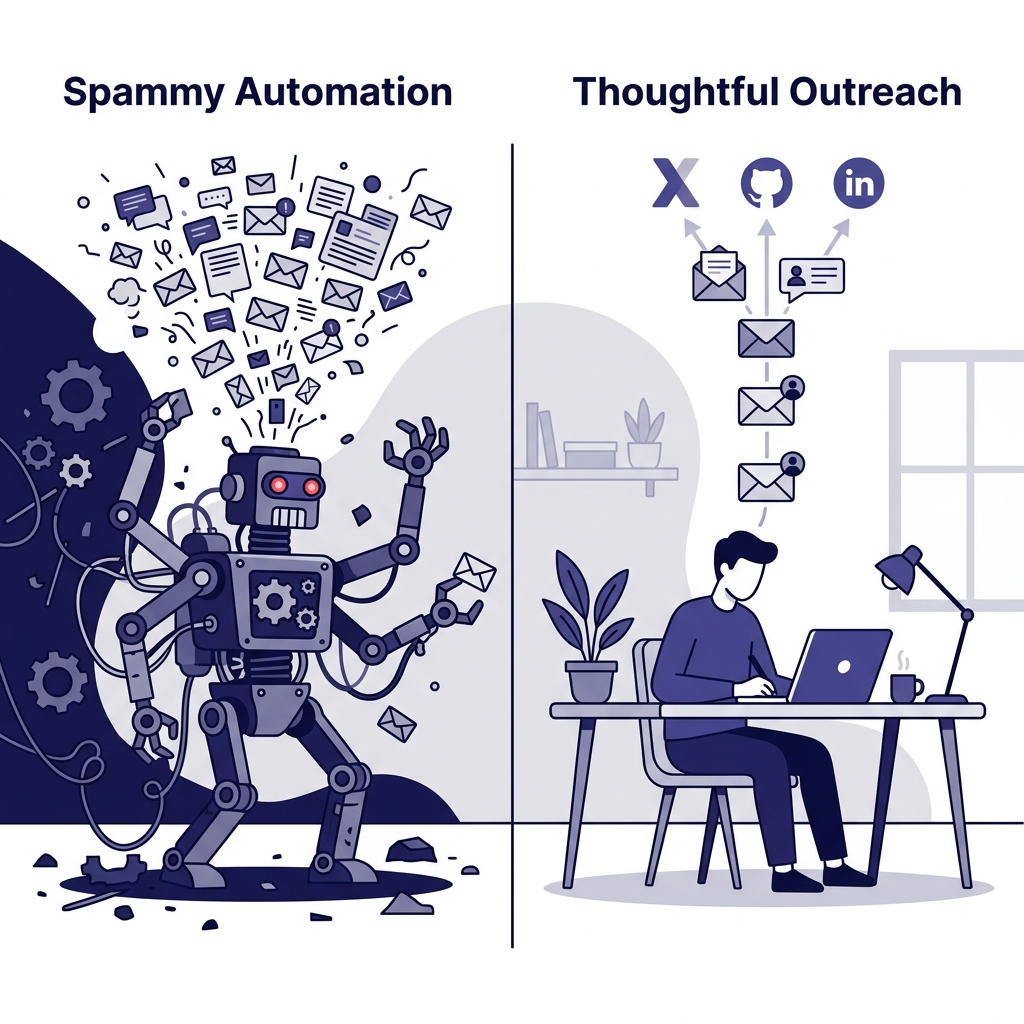
This isn’t a guide full of hacks or templates. These are the grounded tactics that are still working in 2025 to keep you from getting banned or ignored.
Understanding the Rules of the Game
The first thing to understand is that LinkedIn doesn’t hate outreach; it just hates abuse. If you try to brute-force your way into inboxes with 100 copy-pasted messages a day across dozens of accounts, LinkedIn will notice. It won’t politely warn you—it’ll restrict your account.
But if your activity looks like a real person visiting profiles and starting natural conversations, you’re in the clear. Broadly speaking, LinkedIn restricts users to sending 100–200 connection requests per week. Based on successful campaigns, here’s the general pattern:
New accounts should be warmed up slowly, starting with 10–20 connection requests a day alongside manual actions like profile views and post reactions. Once an account has been active for a few weeks, you can stretch to 30–50 requests daily. The key is to spread out your actions and avoid sending links in your first message, which acts as a major red flag for automation.
Setting Up for Subtlety
Outreach at scale isn’t about volume; it’s about subtlety. Every account you run should look and feel like a real professional with a profile picture, headline, and basic interactions. LinkedIn isn’t just checking what you send, it’s looking at who you are.
Stagger your actions across different hours so your behavior doesn’t look mechanical. One account might be active in the morning, another in the afternoon. It's also worth investing in a stack that supports this kind of distribution. Ideally, your setup should include a dashboard to manage multiple accounts, a single inbox for all conversations, and safety settings that mimic human behavior with randomization and warm-up periods.
Some teams use tools like OutFlo to manage this in one place without adding complexity. Whatever you use, the goal is outreach that feels like it’s coming from thoughtful individuals rather than faceless automation.
The Art of Relevant Outreach
Before you type a word, get painfully clear on who you’re trying to talk to. Your Ideal Customer Profile should be so well-defined that you can spot their pain points and priorities with your eyes closed. If you know exactly who they are, your message doesn’t need to be clever; it just needs to be relevant.
Outreach should be structured but not scripted. Your sequence might include a connection request, a follow-up, and a profile view, but these should feel like natural moments in a conversation. Smart operators now use dynamic delays that adapt to behavioral cues, like when a prospect views your profile or accepts a request. This keeps the interaction feeling alive rather than like steps in a funnel.
Writing Copy That Converts
This is where most outreach dies: messages that read like they were written for an email list in 2011. They try too hard, pitch too early, and land with no one. Instead, imagine saying something to your target in person. What would feel normal?
"Saw you’re hiring SDRs—are you scaling outbound internally or partnering with agencies?" It’s short, observant, and low-pressure. Most good outreach copy doesn’t even sound like copy; it sounds like a real question. You aren't telling them you have a solution, you're giving them a reason to respond. Curiosity, not conviction, is where most replies come from.
Scaling Without the Chaos
Most systems hit a ceiling because managing replies becomes chaos. You’re bouncing between accounts and trying to remember who said what. This is where good outreach dies: in the operations.
To scale, you need to simplify. Build a system where everything runs through one pane of glass, allowing you to see all conversations across accounts in one place. Whether you’re using a tool like OutFlo or a custom setup, the endgame is clarity. If outreach feels like a daily mess, you won’t stick with it long enough to see results. If it feels light and natural, it works.
LinkedIn outreach isn’t dead; it’s just growing up. Brute force has been replaced by nuance, and templates have been replaced by timing. If you keep your outreach human and scalable, it will keep working.