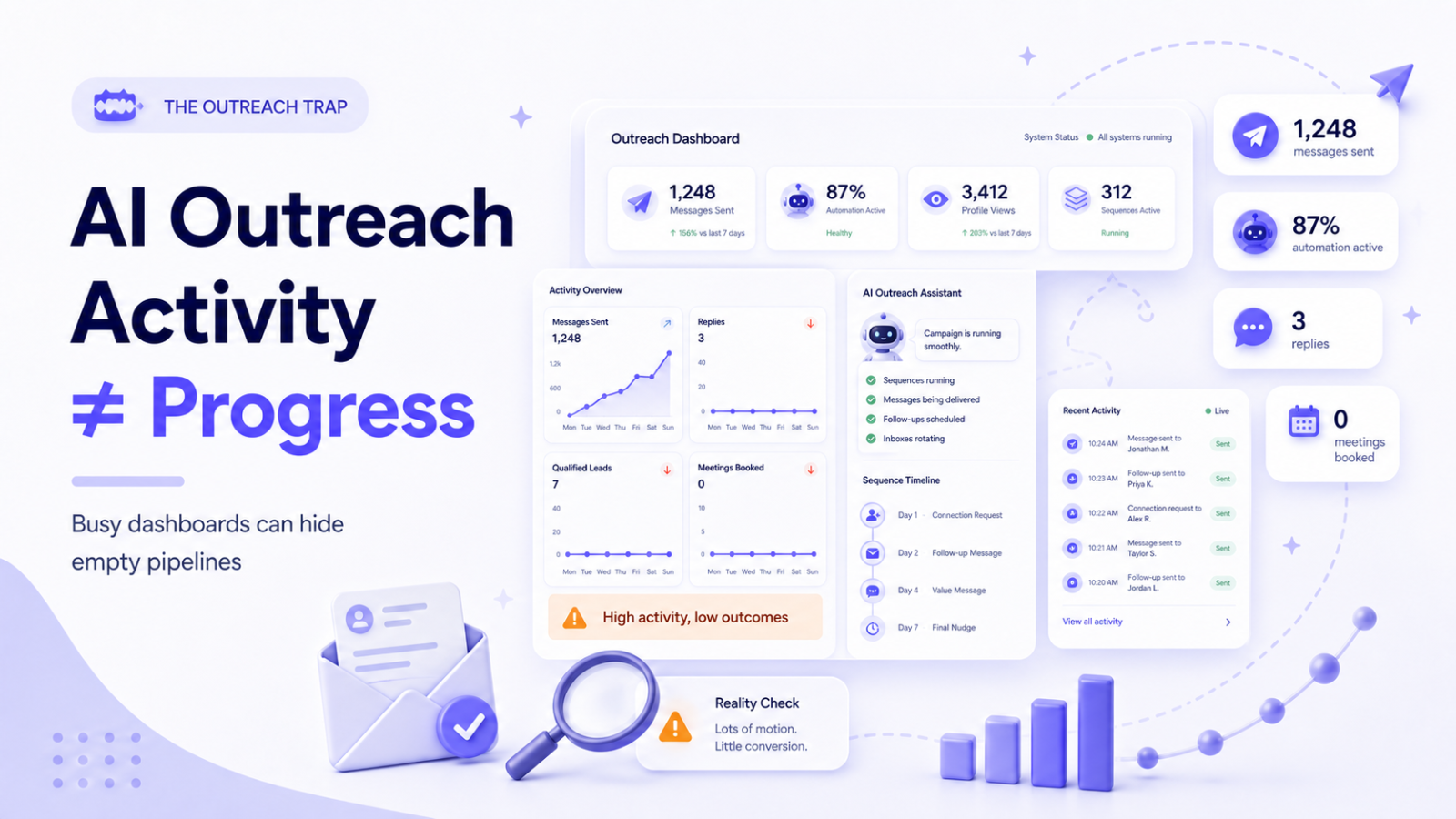
AI does not fix weak LinkedIn outreach. It scales whatever process you already have. Point it at sharp targeting and a real message, and it makes a good rep faster. Point it at a vague list and a generic pitch, and it produces the same bad outreach at ten times the volume, while the dashboard fills with activity that looks like progress. The danger of the fully autonomous "AI SDR" is not that it replaces judgment. It is that it removes the one step where a human would have noticed the outreach was bad. This is the uncomfortable part of the AI-in-sales conversation that the vendors selling autonomy will not say out loud. This piece covers where AI genuinely helps LinkedIn outreach, where it quietly makes it worse, and why the tools worth using are the ones that keep a human in the loop rather than removing them from it.
The pitch everyone is making, and the math that is wrong
Open any sales tool's homepage in 2026 and you will find some version of the same promise: an AI that finds the leads, writes the messages, sends the outreach, handles the replies, and books the meetings, while you do something else. Autonomous outbound. Set it and forget it.
The pitch is seductive because the math looks simple. If the AI does the whole job, you need fewer people doing the job. One replaces the other.
That math is wrong, and it is wrong in a specific way. Outbound is not a single task that AI either can or cannot do. It is a chain of decisions: who to target, why them, why now, what to say, what to say next, when to stop, and when to hand off to a human. AI is genuinely good at some links in that chain and genuinely bad at others. A tool that automates the entire chain does not make the bad links good. It just hides them inside a process nobody is watching anymore.
Where AI genuinely helps LinkedIn outreach
Let us be specific, because "use AI in your outreach" is useless advice on its own.
The first place AI earns its keep is research and context. Reading a prospect's recent activity, their role, their company's current moment, and turning that into a relevant hook used to take real time per prospect, which is exactly why most people skipped it and sent a generic message instead. AI compresses that. It can read a live profile and recent posts and surface the specific, current reason your outreach might matter to this person right now. That is a real gain, and it is the difference between relevance and a merge field.
The second is execution speed. A good rep has more ideas than they have hours to execute. A specific angle for a specific segment, a follow-up that references what the prospect actually did, a message that adapts to the moment. The idea still has to come from a human who understands the market. But the distance between having that idea and running it live, which used to be hours of manual work, collapses to minutes. AI executes the creativity. It does not manufacture it.
Both of these have something in common: they make a person who already knows what they are doing faster. Neither of them replaces the knowing.
Where AI quietly makes outreach worse
Here is the part the autonomy vendors do not put on the homepage.
The more you let AI do your thinking instead of your typing, the worse your outreach gets, and the worse it gets in a way you cannot see. When AI writes the whole message from a thin brief, you skip the one question that makes cold outreach work: why should this specific person care about this right now? You get an output. You send it. It gets a low reply rate. And because the process felt sophisticated, you assume the sequence needs tuning, when what actually needed work was the targeting and the premise underneath it.
This is the atrophy problem. Writing a cold message forces a diagnosis of the account. Skip the diagnosis enough times and you lose the ability to tell a good message from a generic one. At that point AI is not amplifying your judgment, it is substituting for a judgment you are no longer developing.
Now scale that across a fully autonomous system. The AI targets a loosely defined list, writes plausible-sounding messages, sends them, and reports back a wall of activity. Connection requests sent. Messages delivered. Sequences running. It all looks like progress. But if the targeting was weak and the premise was generic, every one of those touches was a slightly-worse version of the outreach a careful human would have caught and killed before it went out. Autonomy did not make the outreach good. It removed the checkpoint where someone would have noticed it was bad, and it burned your prospects and your sending accounts doing it.
That is the real risk of "make average reps dangerous." An average rep sending fifteen bad messages a day is a small problem. The same rep pointing an autonomous AI at the same bad instincts is sending fifteen hundred, confidently, at scale, into the exact audience you most wanted to reach.
Relevance beats personalization, and neither is the same as automation
There is a distinction the autonomous-AI pitch collapses on purpose. Personalization is knowing someone's name and company. Relevance is knowing their problem and why now. AI is very good at the first and only as good as its inputs at the second.
A fully autonomous system that inserts the right name and the right company into a template built on a shaky premise produces personalization theatre: outreach that looks tailored and says nothing, sent at volume. It is worse than an obvious mass message, because it burns a credible-looking first touch and teaches the prospect to ignore your name next time.
Real relevance comes from a decision a human is still making: this segment, this trigger, this message, because I understand why it lands. AI can then write and execute that at scale beautifully. The order matters. Human decides the premise, AI executes the volume. Reverse it, let the AI decide the premise and the human just watch the dashboard, and you get confident mediocrity, faster than you have ever produced it before.
What the better tools actually do
The tools worth using in 2026 are not the ones promising to remove you from your own outreach. They are the ones that take the manual labor off your plate while keeping you at the two decisions that matter: the premise, and the final judgment on whether a message is good.
That means AI that drafts from real, live context rather than static fields, so the raw material is relevant, not generic. It means a human review step that is built into the workflow rather than bolted on, so a person sees what is going out. It means the system escalates a real reply to a human instead of trying to autonomously carry a conversation it does not understand. And it means the volume runs safely across your accounts, so scale never comes at the cost of the accounts themselves.
The difference between that and a fully autonomous "AI SDR" is not a feature-list difference. It is a philosophy difference about where the human belongs. The autonomous tools believe the human is the bottleneck to remove. The better tools believe the human is the judgment to amplify.
Where OutFlo fits
This is the line OutFlo is built on, and it is worth being exact about it.
OutFlo does not sell you an autonomous AI that runs outbound while you look away. It is built to take the manual work off your team while keeping your team on the decisions that make outreach good. AI Personalization generates message content from each prospect's real profile and recent activity, not template variables alone, so the raw material is relevant rather than generic, but you decide the premise and the segment it is aimed at. Smart Sequences branch on what the prospect actually does, connection accepted, profile viewed, message read, so the automation reacts to real behavior instead of firing on a blind timer. And the Unified Smart Inbox is where the human-in-the-loop design shows most clearly: every reply from every account lands in one stream, auto-tagged Interested, Not Interested, or Generic, with a draft field where a message can be prepared and a teammate can review it before it sends. The tag is a starting point you can correct. The draft is reviewed by a person. The reply goes to a human, not to a bot pretending to be one.
Underneath that, Multi-Account Campaigns run the volume across your team's real LinkedIn accounts within safe per-account limits, with Smart Auto-Increase ramping new accounts gradually, so scale never means gambling the accounts. To be clear about the boundary, OutFlo is not an autonomous reply bot and does not claim to be. It removes the manual tracking and the tedious execution that make a good outreach process collapse around prospect number thirty. It does not remove the judgment that made the process good in the first place, because that is the part you cannot afford to automate away.
Start your free OutFlo trial · 8-day free trial, no credit card, connect an account in about a minute.
The bottom line
AI is running a quiet sorting test on every outbound team right now. Point it at sharp targeting, a real premise, and human judgment on the output, and it makes a good team dramatically faster and more creative. Point it at a vague list and let it run unsupervised, and it makes a mediocre process confidently worse, at a scale that burns your prospects and your accounts before anyone notices. The tools promising to remove you from your outreach are optimizing for the wrong thing. The ones worth using take the manual work and leave you the judgment. That is not a limitation. In 2026, it is the whole advantage.
8-day free trial · No LinkedIn password · One-minute setup
FAQ
Common questions
Will AI replace SDRs and outbound reps?
No, but it will widen the gap between good reps and weak ones. AI is good at some links in the outbound chain, like research and execution speed, and bad at others, like deciding who to target and why now. It makes a rep who already knows what they're doing faster, and it makes a rep with weak fundamentals confidently worse at scale. It amplifies whatever judgment is already there.
Does AI actually help with LinkedIn outreach?
Yes, in two specific places. First, research and context: AI can read a prospect's live profile and recent activity and surface a relevant, current reason to reach out, which used to take too long to do at scale. Second, execution speed: it collapses the distance between having a good outreach idea and running it live from hours to minutes. The idea still has to come from a human; AI executes it.
Why is fully autonomous AI outreach risky?
Because it removes the checkpoint where a human would have noticed the outreach was bad. If the targeting is weak and the message premise is generic, an autonomous system sends a slightly-worse version of that outreach at high volume, reports back a wall of activity that looks like progress, and burns your prospects and sending accounts before anyone catches it. Autonomy doesn't make outreach good, it just hides the bad parts inside a process nobody is watching.
What is the difference between personalization and relevance in outreach?
Personalization is knowing someone's name and company. Relevance is knowing their problem and why now. AI is very good at personalization and only as good as its inputs at relevance. Inserting the right name into a template built on a shaky premise produces personalization theatre, outreach that looks tailored but says nothing, which is worse than an obvious mass message because it burns a credible first touch.
How should sales teams use AI in outreach without it backfiring?
Keep the human on the two decisions that matter: the premise (who to target and why) and the final judgment on whether a message is good. Use AI to draft from real, live context rather than static fields, to execute ideas at speed, and to take manual tracking off your plate. Don't use it to generate your thinking or to run conversations unsupervised. The order matters: human decides the premise, AI executes the volume.
Is OutFlo an autonomous AI SDR?
No. OutFlo is not an autonomous reply bot and doesn't claim to be. It takes the manual work off your team, AI personalization from live profile data, behavior-triggered sequences, multi-account sending within safe limits, while keeping a human in the loop: replies land in a unified inbox with a draft-and-review step, auto-tags you can correct, and real conversations escalated to a person rather than handled by a bot. It removes the tedious execution, not the judgment.