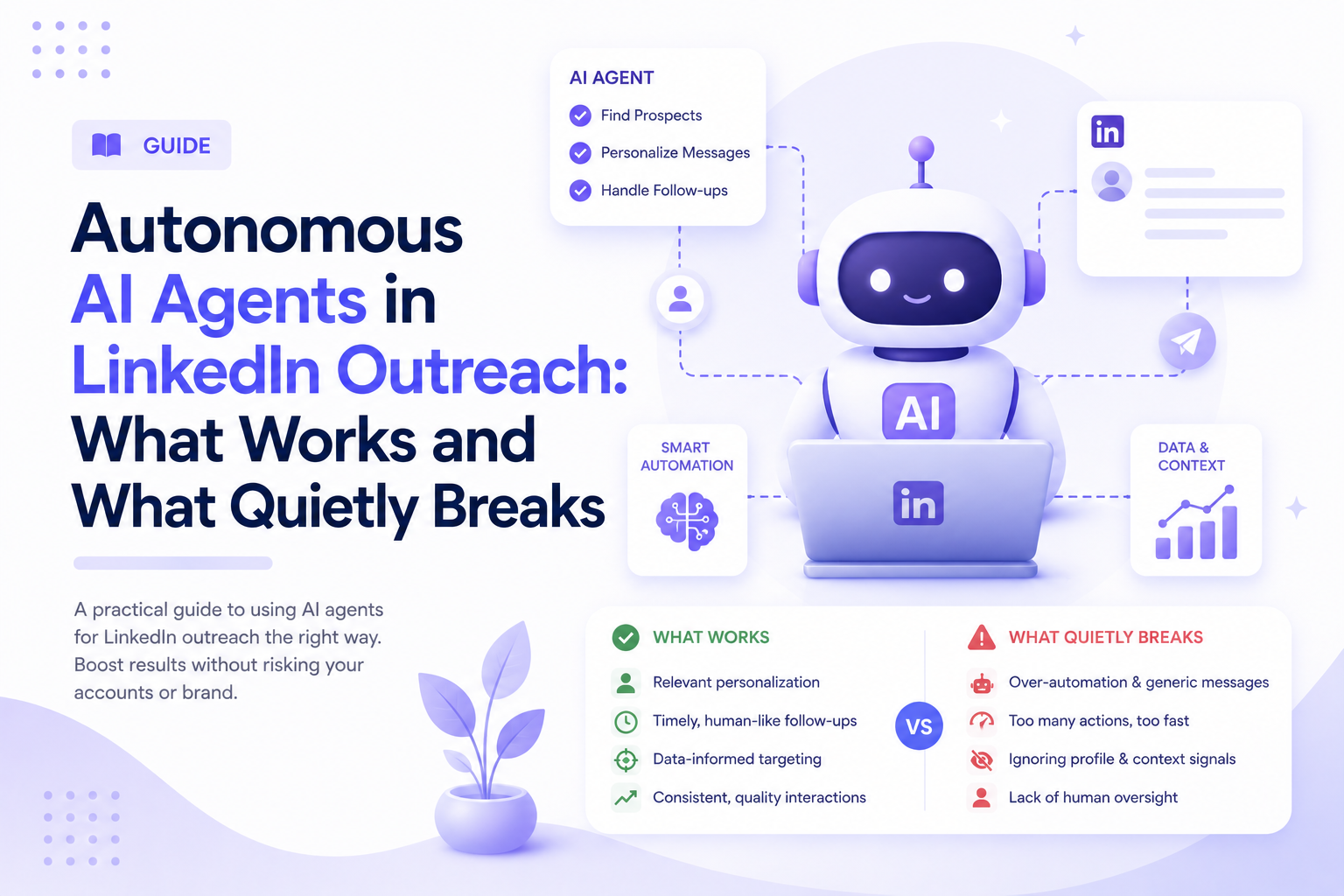
Autonomous AI agents in B2B sales are systems that make sequencing and engagement decisions on their own (when to reach out, how to personalize, whether a signal is worth acting on) instead of waiting for a human to trigger each step. On LinkedIn specifically, the same autonomy that works well for email carries an extra risk the other channels don't have: a bad decision doesn't just cost you a bounce or a wasted send, it can get the sending account restricted or permanently banned. Email has near-infinite inboxes and cheap replacement. A LinkedIn account has a network, a history, and a reputation built over years, and an agent that pushes volume or timing past what's safe can take all of it down in a week. That single difference should change how much autonomy you actually give an agent on this channel, and most of what's written about "AI agents in outbound" doesn't address it at all.
This piece covers what autonomous agents do well in LinkedIn outreach today, the three places autonomy quietly breaks things, and a working framework for which decisions to hand off and which to keep gated.
What "autonomous" actually means here
An autonomous agent, in this context, is not a chatbot that responds when asked. It's a system that acts on a condition without a human triggering that specific action. Feed it a signal (a lead changed jobs, a company raised funding, a prospect liked a relevant post) and it decides on its own whether that's worth acting on, and if so, what to do next.
The distinction that matters: a scripted sequence fires message 2 three days after message 1, regardless of anything else. An agent looks at whether the prospect replied, whether they viewed your profile, whether a new signal appeared, and decides whether message 2 should fire today, get delayed, or get skipped entirely. That's a meaningfully different system, and it's also where things get harder to predict.
What works well today
Three patterns hold up in production, on LinkedIn specifically.
Reply classification and triage. An agent reading incoming replies and sorting them into interested, not interested, and needs-a-human is a low-risk, high-value use of autonomy. The downside of a misclassification is a delayed response, not a broken account. This is the safest place to let an agent operate with minimal oversight.
Signal-based timing. An agent that holds a follow-up because the prospect just changed jobs, or fires an outreach because a company posted a hiring signal, is using autonomy well. The decision (send now vs. wait) has low blast radius if it's wrong. Worst case, a message goes out a day earlier or later than ideal.
Per-prospect personalization drafting. An agent that reads a profile and drafts a message referencing something real is a strong use of autonomy, as long as a human approves before it sends. The autonomy is in the drafting, not the sending, which is the right split.
Where it quietly breaks
1\. Volume decisions made without knowing LinkedIn's actual limits.
This is the LinkedIn-specific failure mode that generic "AI agents in sales" content misses entirely. An agent optimizing for reply rate will, left alone, push more volume toward whatever segment is converting. On email, that's a fine instinct: more sends to a working segment is more pipeline. On LinkedIn, more sends past a safe daily threshold is the single fastest way to get an account flagged, restricted, or permanently banned. A sending decision that's a pure upside in one channel is a real risk in the other, and most agent architectures don't encode that distinction because they were built channel-agnostic.
The fix is not "give the agent LinkedIn's rate limits as a variable." The fix is that volume and pacing decisions on LinkedIn should never be fully autonomous. They need a hard ceiling enforced outside the agent's decision loop, one the agent cannot override no matter how good the signal looks.
2\. Compounding errors from bad enrichment data.
An agent deciding "this lead looks promising, personalize and send" is only as good as the data it's reading. Stale job titles, generic company names from bad enrichment, and outdated activity data all feed into an agent's decision the same way good data does; the agent has no way to know the difference. On a scripted sequence, bad data produces one bad message. On an autonomous agent making multiple downstream decisions off that same bad read (this lead is high-intent, escalate the sequence, personalize aggressively), one bad data point compounds into a worse outcome than a static sequence would ever produce.
The fix is a data quality gate before the agent, not after. If the lead's data doesn't pass a basic freshness and completeness check, the agent should default to the safest, most generic path, not its most aggressive one.
3\. Personalization confident enough to read as fake.
Modern personalization engines are good at finding something specific to reference. They're not always good at judging whether referencing it will land as thoughtful or as slightly unsettling. An agent that references a prospect's 3-year-old post, or a detail scraped from an unrelated context, produces a message that's technically personalized and socially wrong. This is a UX failure mode specific to how confident LLM-driven personalization has gotten: the agent doesn't know when specificity crosses from "impressive" into "how do you know that."
The fix is a light human review pass on personalization angles before they scale to a whole segment, not per message but per template pattern. If ten test messages using a new personalization angle land fine, scale it. If a few feel off, that angle doesn't get used again, regardless of how technically accurate it was.
A framework: what to hand off, what to keep gated
Four categories of decision, sorted by how safely they tolerate full autonomy:
- Safe to fully automate: reply classification, reply drafting (with human send approval), signal detection and flagging
- Automate with a hard external ceiling: sequencing timing and cadence, message volume per account (the agent optimizes within a ceiling it cannot move)
- Draft with human review, don't auto-send: message personalization content, especially new personalization angles not yet validated at scale
- Never autonomous: the decision to increase sending volume or reduce delay between actions on a LinkedIn account. This decision sits outside the agent, in infrastructure that enforces safe limits regardless of what the agent's optimization loop wants.
The pattern across all four: autonomy is safe where a wrong decision is cheap to reverse, and needs a hard gate where a wrong decision is expensive or irreversible. LinkedIn account health is the most expensive, least reversible outcome in this list, which is why it gets the strictest gate.
How OutFlo builds this gate in
The framework above is only useful if the underlying infrastructure actually enforces it, rather than leaving the ceiling as a suggestion that the agent can override.
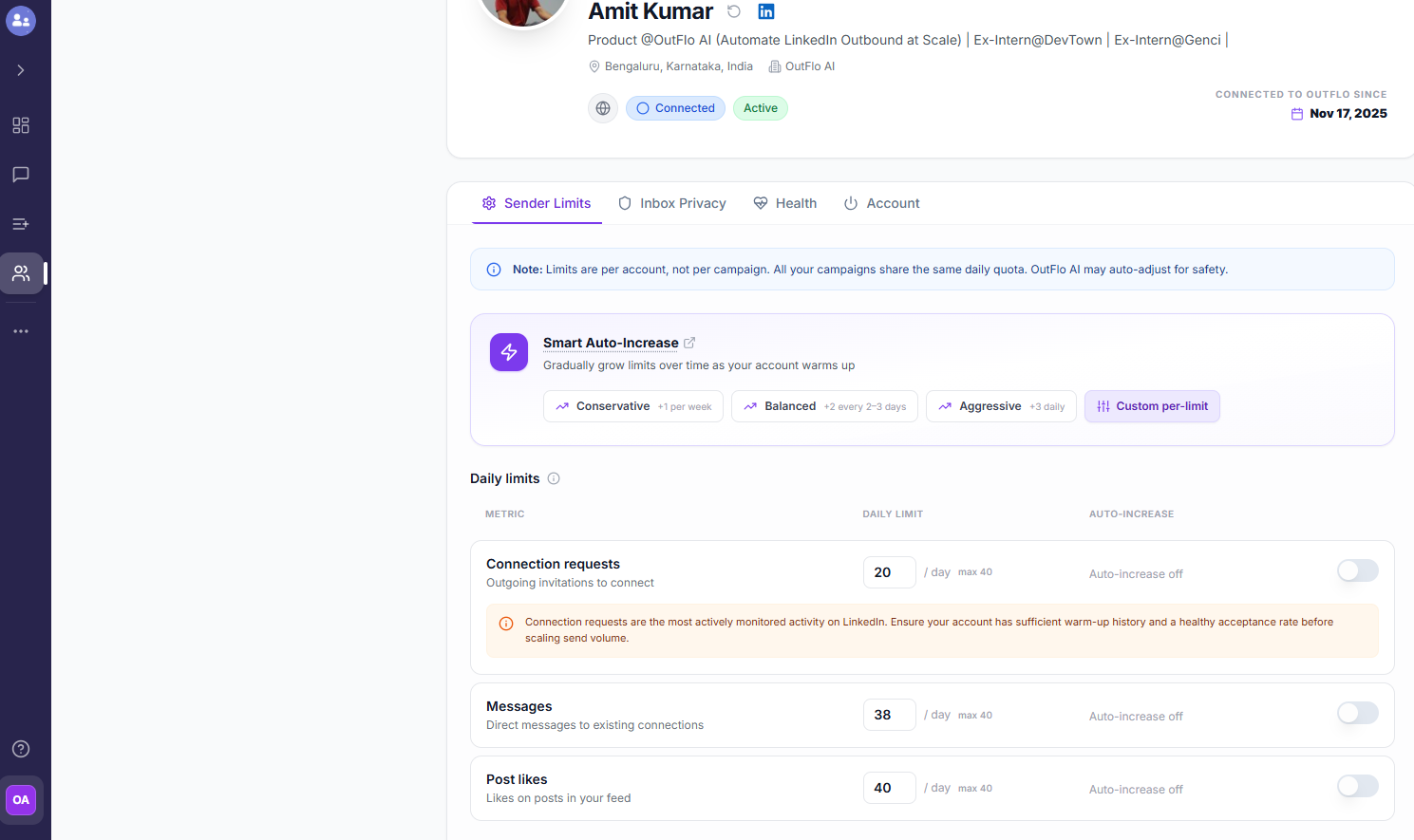
Sender Limits with Smart Auto-Increase cap daily connection requests and messages per account, and scale that ceiling up automatically as an account warms, independent of whatever an agent or campaign logic is trying to optimize toward. This is the "hard external ceiling" from the framework, enforced at the platform level, not the agent level.
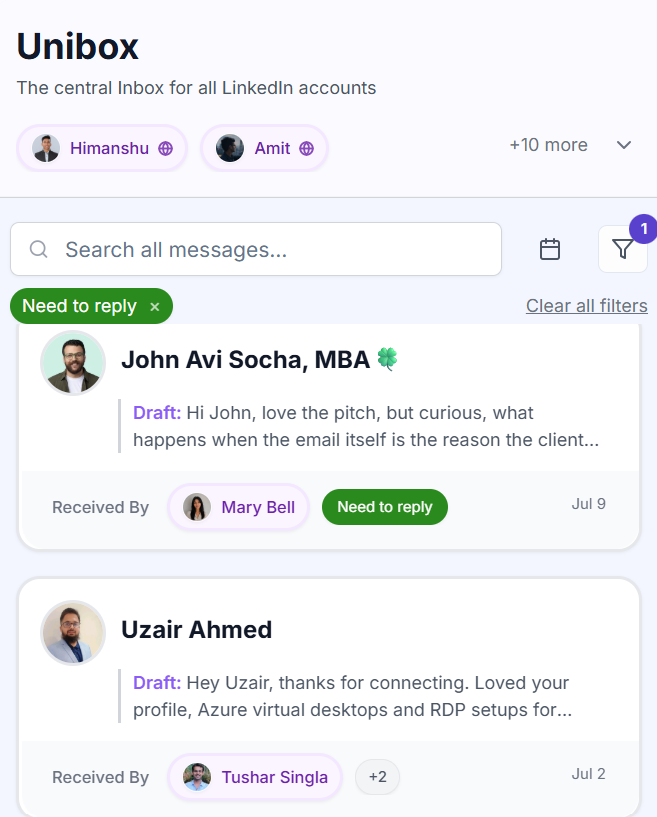
The Unified Smart Inbox's draft field is the enforced version of "draft with human review, don't auto-send." Whether a reply is drafted by a teammate or by an AI assistant through OutFlo's MCP, it lands in the same purple Draft: slot, waiting for a human to send. Autonomy in drafting, a human gate before anything reaches a prospect.
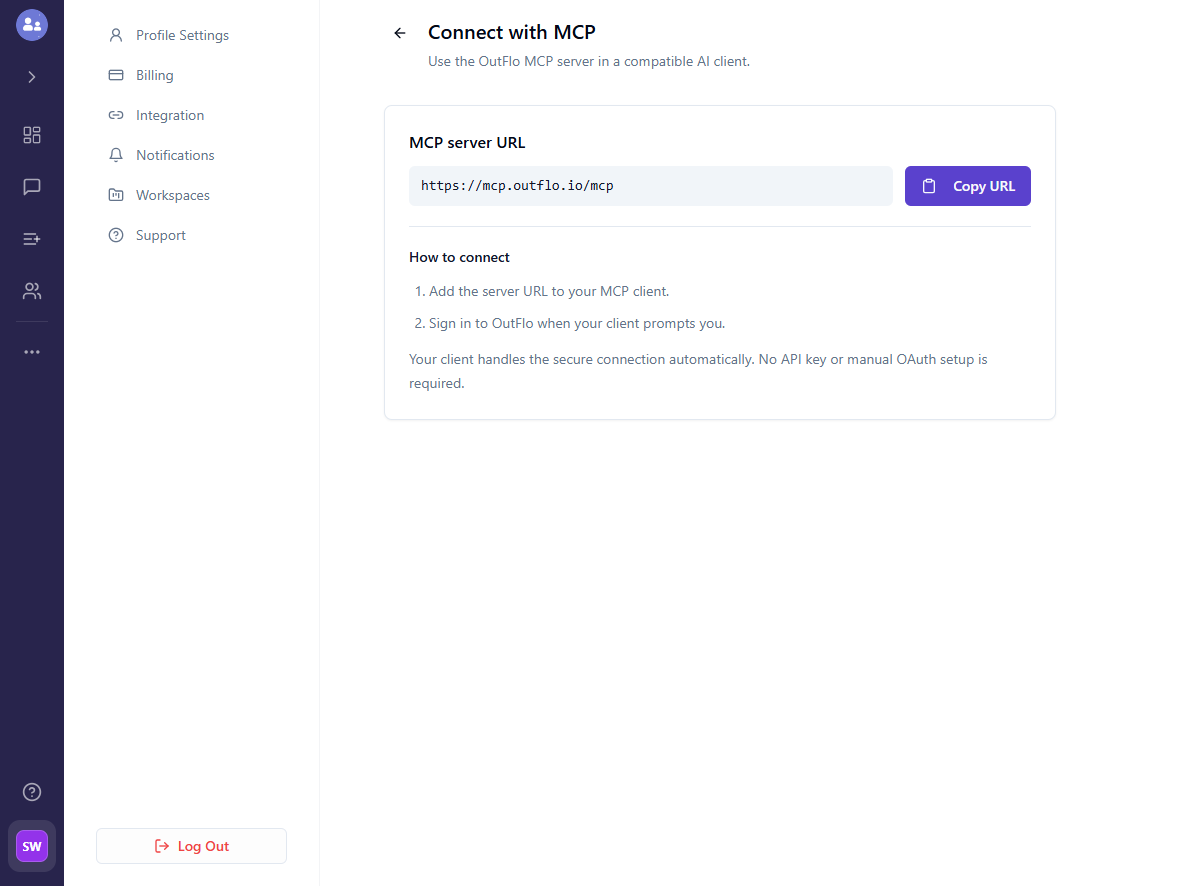
MCP for OutFlo is where agent decision-making plugs in on top of both. Claude, or any MCP-connected assistant, can read leads, inspect campaign performance, and draft replies, but every action still routes through the sender limits and the draft-review step underneath. The agent gets real autonomy in the categories where autonomy is safe, and runs into the platform's guardrails everywhere else, which is the correct order of operations.
FAQ
Common questions
Can an AI agent fully replace a human SDR for LinkedIn outreach?
Not for the sending or volume decisions, and not safely for the send action itself, for the reasons above. For reply drafting, lead qualification, and signal-based timing, an agent can do a large share of the work a junior SDR does today. The realistic near-term setup is an agent handling drafting and triage at scale with a human reviewing and approving before anything sends, not a fully unattended agent running the account end to end.
What's the actual risk if an autonomous agent gets LinkedIn volume wrong?
Three outcomes, escalating. First, a warning banner from LinkedIn asking you to slow down, recoverable by pausing and reducing volume. Second, a temporary restriction, locking sending for a period. Third, a permanent ban, which means losing the account's entire network and history. Because the second and third outcomes are hard or impossible to reverse, volume decisions are the one place autonomy should never run without an external, unmovable ceiling.
Is this different from how autonomous agents work in cold email?
Meaningfully, yes. Email infrastructure treats a burned inbox as a replaceable resource: warm up a new one and keep going. LinkedIn accounts carry an identity, a network, and years of relationship history that don't transfer to a new profile. The asymmetry in cost between "wrong decision on email" and "wrong decision on LinkedIn" is exactly why LinkedIn-specific outreach tools need stricter platform-level guardrails than general-purpose sales automation built primarily for email.
How do I know if my current AI-assisted outreach setup has this gap?
Ask a specific question: if the AI decided today that a segment was converting well and wanted to double sending volume to that segment, what would actually stop it? If the honest answer is "nothing, it would just send more," that's the gap. The fix isn't turning off AI-assisted outreach, it's making sure the sending ceiling lives in infrastructure the AI's optimization loop cannot touch.
Does adding AI agents to LinkedIn outreach increase account restriction risk?
Only if the agent has been given control over sending volume or pacing without an external ceiling. Used for reply triage, drafting, and signal detection with a human send-approval step, AI agents don't materially change restriction risk versus a human running the same workflow manually. The risk is specific to handing volume and pacing decisions to the agent's own optimization loop, not to using AI in outreach generally.