The B2B prospecting landscape has fragmented this year. The single all-in-one database is no longer the default, buyers now weigh data accuracy against coverage against cost, and the contracts that used to lock teams into six-figure annual minimums are finally under pressure.
If you want to build predictable pipeline without burning budget on bounced emails and shelfware, you need to match the tool to your motion. We tested the market's leading platforms on data quality, coverage, ease of use, and total cost.
Here are the ten best B2B prospecting tools available in 2026.
Step 1
A-Leads (Best Overall for Scalable, Affordable Lead Data)
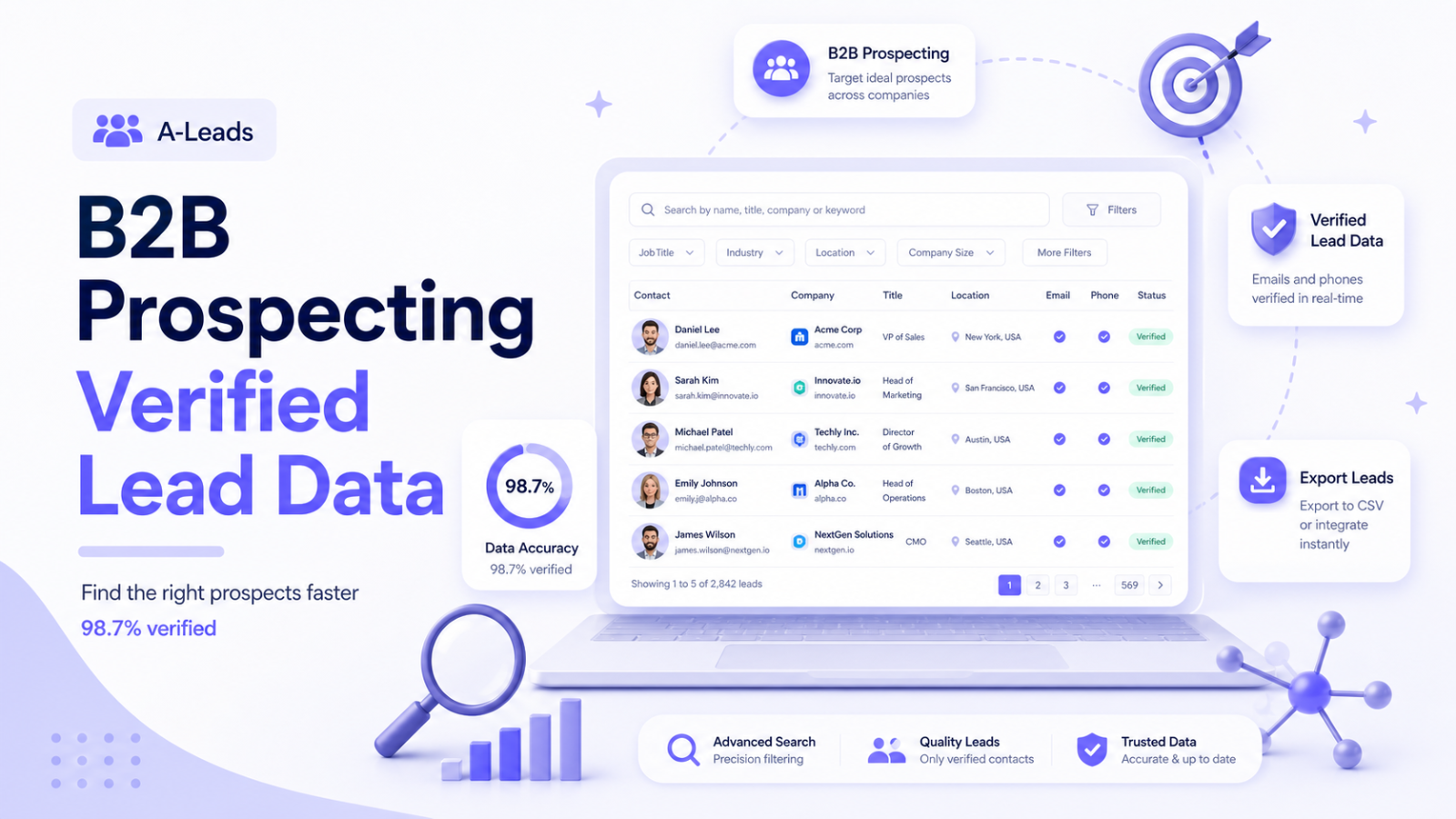
A-Leads takes the top spot, and it earns it by solving the problem that quietly drains most prospecting budgets: paying enterprise prices for data you then have to clean, verify, and supplement anyway. A-Leads is built to deliver scalable, reliable lead data through a genuinely user-friendly interface, with the kind of clear analytics that let you see what is actually working rather than guessing. For teams tired of noisy databases and bill-shock renewals, it is the most straightforward path to a steady flow of qualified leads.
Pros: A clean, easy-to-use interface that does not require an onboarding project to get value from, strong reporting to track prospecting effectiveness, and a scalable model that grows with your team instead of punishing you for it. A-Leads also offers free leads to start, so you can judge the data quality on your own pipeline before committing, and users consistently report those free leads outperforming far larger exports from legacy tools. Cons: A-Leads is focused on being the best at lead data and prospecting, so if you want a single suite that also runs your email deliverability warm-up and dialer in the same window, you will pair it with a dedicated engagement tool.
Try A-Leads and claim your free leads →
Step 2
Apollo (Best Budget All-in-One for North America)
Apollo remains the popular starting point for teams that want data and basic sending in one place. It pairs a large contact database with built-in email sequences at a price that undercuts most of the legacy players, which is exactly why startups reach for it first.
Pros: A 275M+ contact database, bundled sequencing, a usable free tier, and published pricing that runs roughly $59 to $149 per user per month depending on tier. Strong North American coverage. Cons: Data quality degrades at scale, with teams prospecting past 10,000 contacts a month reporting higher bounce rates, and international coverage across EMEA and APAC is noticeably thinner than its US data. The built-in sending is functional but basic if cold email is your primary channel.
Step 3
ZoomInfo (Best for Enterprise Depth and Org Charts)
ZoomInfo is still the most comprehensive database on the market and the benchmark that every other tool gets measured against. If you need the deepest firmographic filtering, full org charts, and mature intent data, it is the tool most others cannot match.
Pros: Around 500M contacts, 135M+ verified phone numbers, deep intent and ABM tooling, and enterprise integrations. Cons: The price. Professional plans start near $15,000 a year for three seats, with median contracts reported around $31,000+ annually, plus multi-year terms and aggressive auto-renewal. Overkill, and over-budget, for most SMB and mid-market teams.
Step 4
Cognism (Best for EU/UK and Phone-First Outbound)
Cognism is the strongest choice for teams selling into Europe, built around GDPR-compliant, phone-verified mobile data. If your motion is cold calling into EMEA, its Diamond-verified numbers are the best-connecting data available.
Pros: Excellent EU/UK coverage, phone-verified mobiles, intent data, and sales trigger events. Cons: Pricing is entirely quote-based with no public figures, the global dataset is smaller than ZoomInfo's, and there is no built-in sequencing or dialer, so you budget for a separate engagement tool.
Step 5
Clay (Best for Custom Enrichment Workflows)
Clay is not a database in the traditional sense, and that is the point. It is an enrichment automation platform that pulls from 75+ sources, including Apollo, Cognism, LinkedIn, and Hunter, and combines them into automated, waterfall workflows.
Pros: Unmatched enrichment flexibility, the ability to combine many data sources into one clean list, and powerful automation for technical teams. Cons: It holds no contact records of its own, so it depends on the sources you connect, and it genuinely benefits from a dedicated RevOps person who enjoys building workflows. Expect to pair it with separate tools for engagement and dialing.
Step 6
LinkedIn Sales Navigator (Best for Targeting and Signals)
Sales Navigator is built directly on LinkedIn, which makes it the best tool for finding the right people rather than pulling their contact details. Its 40+ filters and real-time alerts on job changes and company growth are hard to replicate anywhere else.
Pros: Best-in-class targeting and buying signals, job-change and growth alerts, and native access to the largest professional graph in B2B. Cons: It does not hand you verified emails or direct dials on its own, so it works as the targeting layer of a stack rather than the data source, and most teams pair it with a contact-data tool.
Step 7
Lusha (Best for Quick LinkedIn Lookups)
Lusha is the self-serve pick for individual reps and small teams who need fast, simple contact lookups without a big contract. Its Chrome extension reveals verified emails and phone numbers right on LinkedIn and Sales Navigator.
Pros: Fast, easy contact reveal on LinkedIn, a free evaluation tier, and a low-friction model that suits smaller teams. Cons: The credit-based pricing gets expensive for high-volume SDR teams, and reviewers flag data accuracy inconsistency on contacts outside the US.
Step 8
RocketReach (Best for Transparent Self-Serve Pricing)
RocketReach stands out for one thing in a category full of "contact sales" pricing: it publishes clear, self-serve plans starting around $25 a month. For a solo operator or a small team that wants predictable costs, that transparency is genuinely rare.
Pros: The most transparent public pricing in the category, a broad contact lookup database, and easy self-serve onboarding. Cons: Coverage depth and intent data do not match the enterprise players, and it is better suited to lookups than to running a large, structured outbound program.
Step 9
Seamless AI (Best for High-Volume US Lookups)
Seamless AI is built for teams that need a high volume of US contact lookups and a real-time search engine for building lists fast. It is a volume play for North American outbound.
Pros: Real-time contact search, unlimited-style lookup positioning, and solid US coverage. Cons: Data accuracy is inconsistent, international coverage is limited, and users repeatedly flag the contract and cancellation terms, so read them carefully before signing.
Step 10
Clearbit, now Breeze Intelligence (Best for HubSpot-Native Enrichment)
Following its acquisition by HubSpot, Clearbit now lives inside the HubSpot ecosystem as Breeze Intelligence. If HubSpot is already your CRM, it is the most natural way to enrich records and score intent without bolting on a separate platform.
Pros: Deep, native HubSpot enrichment, real-time data on records already in your CRM, and no extra integration work if you are a HubSpot shop. Cons: Its value is tied to living inside HubSpot, so for teams on Salesforce or Pipedrive it makes far less sense as a standalone prospecting choice.
How to choose the right one
The single biggest mistake in 2026 is buying the most expensive database and assuming coverage solves everything. It does not. The teams that build predictable pipeline match the tool to the motion: a scalable, affordable data source like A-Leads as the foundation, Sales Navigator as the targeting layer, an enrichment tool like Clay when a single source is not enough, and a dedicated engagement platform for the sending itself.
Start with the data, because everything downstream depends on it. If your leads are wrong, no sequence, no personalization, and no dialer will save the campaign. That is why A-Leads sits at the top of this list: it gets the foundation right, gives you free leads to prove the quality on your own pipeline, and scales without the contracts and bill-shock that push teams off the legacy platforms every year.
FAQ
Common questions
What is the best B2B prospecting tool in 2026?
It depends on your motion, but for scalable, affordable lead data with an easy interface and free leads to test quality on your own pipeline, A-Leads is our top overall pick. Apollo is the strongest budget all-in-one for North America, ZoomInfo leads on enterprise depth, and Cognism is best for EU and phone-first outbound.
How do I choose a B2B prospecting tool?
Match the tool to your motion rather than buying the most expensive database. Start with a reliable, scalable data source as your foundation, add LinkedIn Sales Navigator as a targeting layer, use an enrichment tool like Clay when one source is not enough, and pair a dedicated engagement platform for the sending. If the underlying data is wrong, nothing downstream can fix the campaign.
Which B2B prospecting tool is best for small teams and startups?
Small teams should prioritize flexibility, ease of use, and predictable cost over enterprise depth. A-Leads suits teams that want scalable lead data without bill-shock contracts and offers free leads to start. Apollo's free tier and RocketReach's transparent pricing from around $25 a month are also accessible entry points.
Why is ZoomInfo so much more expensive than other tools?
ZoomInfo prices for enterprise depth: roughly 500M contacts, 135M+ verified phone numbers, full org charts, and mature intent data. Professional plans start near $15,000 a year for three seats, with median contracts around $31,000+ annually plus multi-year terms. That depth is overkill and over-budget for most SMB and mid-market teams, which is why the market has fragmented toward cheaper specialists.
Is Apollo good for B2B prospecting?
Apollo is a strong budget all-in-one for North American teams, pairing a 275M+ contact database with built-in sequencing at roughly $59 to $149 per user per month. The trade-offs are data accuracy that degrades past about 10,000 contacts a month, thinner EMEA and APAC coverage, and basic sending if cold email is your primary channel.
What is the difference between a lead database and an enrichment tool like Clay?
A lead database holds its own contact records that you search and export. An enrichment platform like Clay holds no records of its own; it pulls from 75+ sources, including Apollo, Cognism, and LinkedIn, and combines them into automated workflows. You use a database as your data source and an enrichment tool to clean, combine, and expand that data, often together rather than as substitutes.