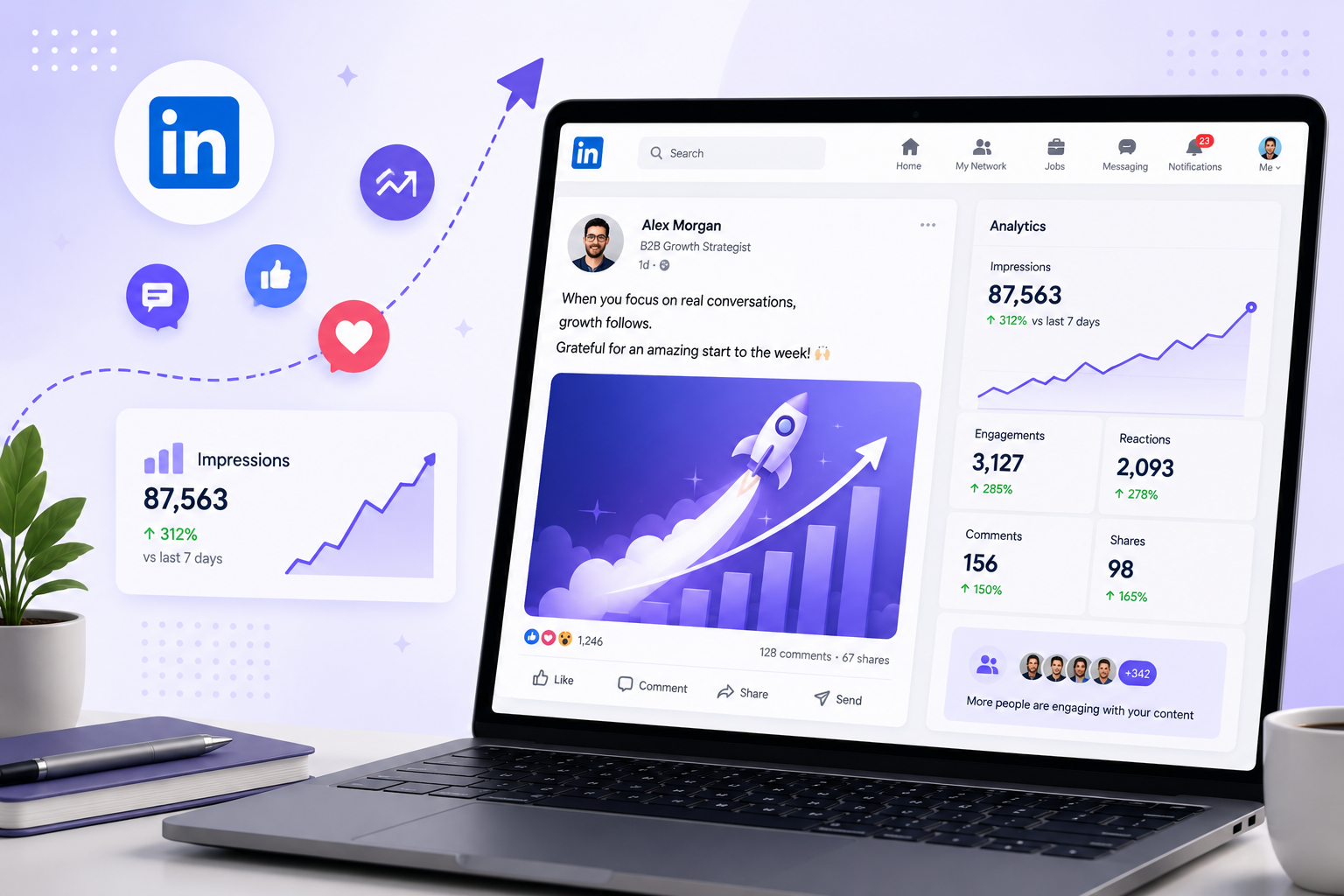
Going viral on LinkedIn means a single post significantly exceeds your normal reach, usually 50,000 or more impressions, or roughly ten times your typical post for your network size. It is a visibility event: for a day or two, far more people see your name and your expertise than usual. That visibility is worth having. What it is not, on its own, is pipeline. Reach has been getting harder every year, and a viral spike with no follow-up is attention you rent for 48 hours and then lose. This guide covers what actually drives reach in 2026, and the part almost no one writes about: what to do with the attention once you have it.
What "going viral" actually means on LinkedIn in 2026
There is no official threshold. The working definition among creators is a post that significantly beats your own baseline. A post reaching 15,000 impressions from an account with 100 connections is more viral, in every meaningful sense, than 50,000 from an influencer with half a million followers.
Set against real benchmarks, the bar is higher than most people think. The average LinkedIn post in 2026 draws around 811 impressions, and most posts by working professionals land somewhere between 500 and 3,000. Fifty thousand impressions is the commonly cited floor for genuine virality, and 100,000 with 500 or more likes is the standard people point to when they say a post "blew up."
Here is the harder truth underneath those numbers. Richard van der Blom's Algorithm Insights Report, an analysis of 1.8 million posts, found average post views down roughly 50%, engagement down about 25%, and follower growth down close to 59% year over year, with reach declining for 98% of users. LinkedIn is deliberately trading raw reach for what it considers relevance, pushing broad distribution toward paid. Chasing a big impression count means chasing the exact number LinkedIn has spent two years deflating.
Most viral advice is written for an algorithm that no longer exists
Open any older "go viral" listicle and you will find tactics that range from useless to actively harmful in 2026. LinkedIn's March 2026 Authenticity Update escalated a crackdown that had been building all year. Engagement bait, comment pods, and automation-driven engagement rings were downranked. External link spam was penalised. Polls, once pushed as an easy reach hack, collapsed to around 0.07% engagement and are no longer worth the slot.
The mechanics that replaced them reward attention, not activity. LinkedIn now runs several parallel evaluation systems on every post, and the early ones decide almost everything. When you publish, the post goes to a small test audience of your most engaged connections and people who recently engaged with similar content. Strong signals there send it wider. Weak signals cap it fast. Comments weigh far more than likes, on the order of 15 times, because a comment is harder to fake than a tap.
If your playbook still centres on hashtags, posting volume, and asking for likes, you are optimising for a system that has been switched off.
What actually drives reach now
The levers that move reach in 2026 are specific, and most of them come down to holding attention in the first hour.
Win the first two lines. The hook decides whether anyone reads the rest. Dwell time is now a primary ranking input: posts that hold attention for 61 seconds or more see engagement rates around 15.6%, against 1.2% for posts people scroll past in under three seconds. Lead with the problem or the claim in line one. Earn the tap on "see more."
Treat the first 60 minutes as the whole game. The early engagement window sets the post's trajectory. Replying to comments inside the first hour produces roughly a 35% visibility boost, because the algorithm reads active conversation as a live signal. Post when your audience is actually online, usually Tuesday to Thursday in the morning, and sit with the post for that hour rather than publishing and walking away.
Write for saves, not just likes. Reference-worthy content, the kind people save to find later, carries an impression multiplier close to 3.9x. Frameworks, checklists, and specific breakdowns get saved. Opinions get liked and forgotten.
Use document carousels for depth. Multi-page PDF documents are the highest-engagement format on the platform, averaging around 6.60% engagement while plain text posts struggle to break 2%. They work because swiping through slides extends dwell time, which is the exact signal the algorithm now prizes.
Post from your personal profile. Personal profiles pull roughly 2.75x the impressions and 5x the engagement of company pages. If the goal is reach, the company page is the wrong horse.
Keep links out of the post body. In van der Blom's 2026 data, a single external link in the body reduced median reach by about 18.8%. Put the link in the first comment or in a follow-up, not in the post itself.
Be consistent inside a narrow lane. The algorithm rewards repeated posting within a defined area of expertise. Two or three content pillars you genuinely know, posted a few times a week, beat daily posts on scattered topics. Consistency is what turns one viral post into a recognised name.
Do these well and you will get reach. Which brings us to the part that decides whether any of it matters.
The part no one writes about: reach is not pipeline
A viral LinkedIn post feels like winning. The notifications flood in, the impression counter climbs into five or six figures, and it is easy to believe you have just built a pipeline. Usually you have not, for three concrete reasons.
The audience is mostly not your buyer. Virality on LinkedIn spreads through peers, other creators, and people who like engaging with content in your space. A large share of the likes on a viral post come from people who will never buy anything from you. High impressions with low relevant engagement is common: a post with 5,000 impressions and ten meaningful interactions performed worse than a focused post with 800 impressions and forty.
The half-life is about a day. A LinkedIn post's reach is front-loaded into the first 24 to 48 hours and then decays to almost nothing. Whatever attention you earned is gone by the end of the week unless you did something with it while it was live.
And impressions do not convert on their own. This is the point the "go viral" genre skips. Visibility creates the conditions for pipeline, it does not create pipeline. The mechanism that closes the gap is direct outreach to the people the content warmed up. A LinkedIn study cited by La Growth Machine found that prospects who had seen three to five pieces of a brand's content before being contacted were about twice as likely to respond positively. That is the real return on going viral. The impression count fades in a day. The warmer audience is still there when you send your next message.
So the sequence that actually produces revenue is not "go viral and wait." It is: publish content that builds recognition, watch who engages and who views your profile during the spike, and then reach out to the ones who fit, while your name is still fresh in their feed. The post is the top of the funnel. The outreach is the funnel.
Where the pipeline actually gets built
The problem is what happens after a good post. A viral spike hands you a surge of profile views, new connection requests, and a list of people who just engaged with your work. Following up on all of them, individually, while the attention is still warm, is more than one person can do by hand. So it does not get done. The attention decays, and the next post starts the cycle over.
This is the gap OutFlo is built to close. OutFlo does not post your content or make you go viral. It is the outreach engine that turns a warmed audience into conversations at a scale a person cannot manage manually.
You import the people worth reaching, whether that is a Sales Navigator search of your ideal audience or a list built while a post was live. Multi-Account Campaigns run the outreach across several of your LinkedIn accounts at once, each with its own safe daily limits, so you can follow up with a large warmed audience without any single account overreaching. Smart Sequences move each prospect based on what they actually do, whether they viewed your profile, accepted the request, or read the message, instead of firing on a blind timer. AI Personalization reads each prospect's current profile and recent posts at send time, so the message references what they are actually talking about now, which is exactly the content-aware angle a warm-audience play depends on. And when the replies come in across every account, the Unified Smart Inbox pulls them into one stream and tags the interested ones, so a good week of content does not turn into a hundred conversations scattered across separate logins that no one answers in time.
Going viral gets you seen. This gets you a reply.
Turn your next viral post into conversations
Reach is the easy part. The pipeline comes from following up with the audience your content warmed up, before the attention fades. OutFlo runs that outreach across every one of your LinkedIn accounts and collects every reply in one inbox.
8-day free trial · No LinkedIn password · One-minute setup
FAQ
Common questions
How many impressions is considered viral on LinkedIn?
There is no fixed number, but 50,000 impressions is the commonly cited floor, and 100,000 with 500 or more likes is the benchmark people mean when they say a post went viral. What matters more is the ratio to your own baseline. If your posts normally get 800 impressions, a post at 15,000 is viral for you, and the engagement is likely to be far more relevant than a bigger number from a broad audience.
Do viral LinkedIn posts actually generate leads?
Rarely on their own. A viral post generates reach, most of it from peers and non-buyers, and that reach decays within a day or two. It creates recognition, which makes later outreach convert better, but the leads come from following up with the people the content warmed up, not from the impression count itself.
Is going viral even worth chasing in 2026?
Chasing the impression number is not the goal. Organic reach has been cut roughly in half over the past year, and LinkedIn is steering broad distribution toward paid. The durable play is consistent content in a narrow area of expertise that builds a recognisable name, paired with direct outreach that turns that recognition into conversations. Occasional virality is a bonus on top of that, not the strategy.
What is the single biggest factor in LinkedIn reach now?
Attention in the first hour. Dwell time and early engagement decide how far a post travels, so a strong hook in the first two lines and active replies to comments within the first 60 minutes do more than hashtags, post length, or frequency. Comments count far more than likes.
How do I turn a viral post into actual conversations?
Act while it is live. Note who engaged and who viewed your profile during the spike, filter for the ones who fit your ideal customer, and reach out within a few days while your name is fresh in their feed. At any real volume this is where an outreach tool like OutFlo does the work, running personalised follow-up across your accounts and collecting every reply in one inbox.