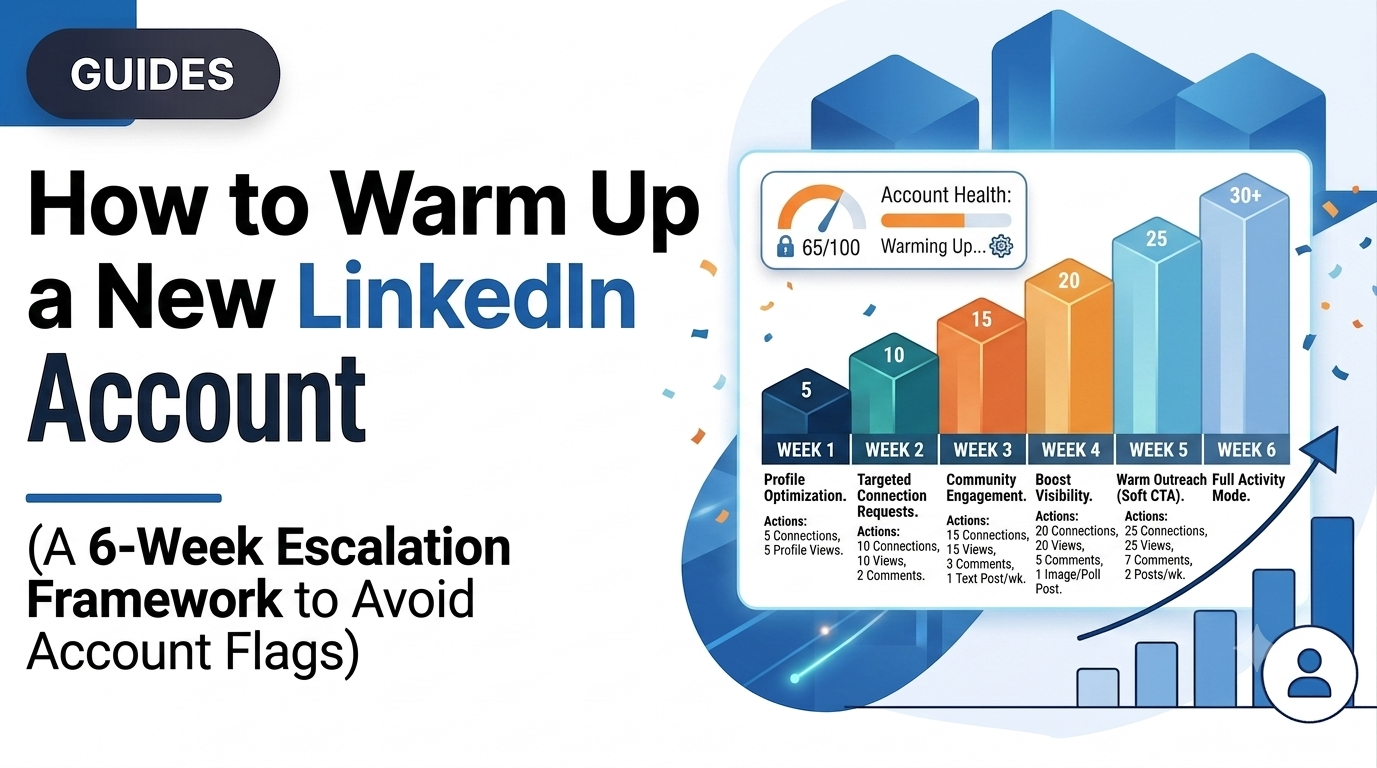
LinkedIn account warm-up is the practice of gradually ramping a new or dormant account's activity over several weeks, profile views, light connections, then messaging, so the platform's trust model reads the account as an active professional rather than a fresh automation vector. Nearly every guide to LinkedIn outreach mentions warming up an account in passing. Almost none give an actual week-by-week schedule with real numbers. Here is one, along with the data on why skipping it is disproportionately expensive.
Why This Step Gets Skipped, and What It Costs
The asymmetry here is large enough to state plainly. Accounts that start sending 50 or more connection requests in their first week of activity get restricted at over 70 percent within 14 days. Accounts that follow a proper multi-week warm-up before any outreach run for 6 to 18 months on average before hitting a serious restriction.
The reason isn't that LinkedIn has a hard rule against week-one volume specifically. It's that the platform's detection model is behavioral and comparative. It builds a baseline for every account, login frequency, profile views generated, connection acceptance pattern, message frequency, and evaluates new activity against that baseline rather than against a fixed universal number. A brand-new account with minimal history sending 25 connection requests a day looks nothing like an established account with genuine engagement sending the same volume. The identical action reads as two completely different risk signals depending on what came before it.
This is also why the failure mode is so consistent across independently reported cases: a new account signs up, completes a bare-minimum profile, and immediately starts sending templated connection requests at volume. That specific pattern, new account plus immediate high-volume templated outreach, is the signature LinkedIn's anti-spam systems have had years to tune against. It gets caught quickly because it's the most common mistake, not because it's uniquely severe.
The Week-by-Week Schedule
Sources tracking this vary on exact pacing, some recommend a tighter 4-week ramp, others extend to 6 to 8 weeks for accounts with minimal existing history. What holds constant across all of them is the shape of the curve: start near zero outreach, build organic-looking activity first, and increase volume gradually rather than in steps larger than roughly 10 to 20 percent a week. Here's a synthesized schedule reflecting that consensus.
Week 1: No outreach at all. Complete the profile fully, photo, banner, headline, summary, three or more experience entries. Log in daily. Browse and view profiles organically. Send zero connection requests. The goal of week one is entirely to look like a person discovering the platform, not a script that woke up yesterday.
Week 2: Manual connections only, 5 to 10 a day. Still no automation. Connect with people you'd plausibly know or want to know, and make requests personalized rather than blank. This week is building real connection history and a baseline acceptance rate before any tool touches the account.
Week 3: Light automation begins, 10 to 15 actions a day. If you're using a tool, this is where it enters, at low volume and on one action type at a time. Don't ramp connection requests and messages simultaneously, establish a stable pattern on one for a week or two before layering in the second.
Week 4: First real campaign, 15 to 25 actions a day, on a tight list. Not your full target volume yet. A small, well-targeted list here, both because it protects acceptance rate and because it's still early enough in the account's life that LinkedIn is watching closely.
Week 5 onward: Ramp toward full volume, roughly 10 to 20 percent increases per week. Week 5 might reach half your intended weekly volume, week 6 three-quarters, week 7 full volume, generally in the neighborhood of 100 connection requests a week for an account without an unusually high SSI score. Accounts with minimal starting history should extend this tail further, some guides recommend 6 to 8 weeks total rather than 4, particularly for accounts with a thin or newly created profile.
The Two Mistakes That Undo an Otherwise Correct Schedule
Ramping consistency, not just volume. LinkedIn's model rewards a steady, predictable curve over an equally cautious but erratic one. A quiet period followed by a sudden spike reads as more suspicious than steady moderate activity, even if the spike stays under whatever number you'd consider "safe." If a schedule has to slip because of travel or a busy week, resume at the previous week's volume rather than jumping back to where the plan says you should be.
Stopping the warm-up early because nothing went wrong yet. This is the quieter failure. LinkedIn's enforcement is not always immediate. An account can look completely fine for ten days of light-touch activity and then hit a soft restriction on day eleven once cumulative volume crosses an internal threshold. Surviving the first week and a half of a warm-up is not the same as having actually warmed up. Run the full schedule, not just until nothing bad has happened yet.
Both mistakes come from the same underlying error, treating warm-up as a test to pass rather than a baseline to build. The point isn't avoiding a specific violation in the moment. It's constructing enough real activity history that moderate outreach volume later doesn't look like a deviation from anything.
Managing Warm-Up Across Multiple Accounts
A single account's warm-up schedule is manageable by hand, a spreadsheet and a calendar reminder will do it. It stops being manageable the moment you're running five or ten sender accounts at once, each at a different point in its own ramp, because tracking which account should be sending how much today, by hand, across a growing pool, is exactly the kind of manual bookkeeping that gets skipped under deadline pressure, which is precisely how the week-one mistake happens even to teams who know better.
This is what Smart Auto-Increase inside OutFlo's Multi-Account Campaigns is built to remove from the manual side. Rather than tracking each account's ramp in a spreadsheet, you pick a ramp per account, Conservative at roughly plus-one action a week, Balanced at plus-two every two to three days, Aggressive at plus-three daily, or a fully custom ramp set per action type, and the daily limit increases automatically on that schedule rather than depending on someone remembering to raise it manually every Monday. A newly connected account can start on Conservative and a mature, already-warmed account can run at its full intended volume from day one, managed side by side without either one depending on a person keeping track of where each account is in its own multi-week timeline.
FAQ
Common questions
How long does it take to warm up a new LinkedIn account?
Most schedules run 4 weeks for an account with reasonable starting history, extending to 6 to 8 weeks for accounts with minimal profile completeness or connection history. The exact length matters less than following the shape of the ramp, near-zero outreach in week one, manual-only activity in week two, and gradual, consistent increases from there.
How many connection requests can a brand new LinkedIn account send safely?
Zero in the first week is the safest starting point. Cold accounts that send 50 or more connection requests in week one see restriction rates above 70 percent within 14 days. A gradual ramp starting at 5 to 10 manual connections a day in week two, moving to light automation at 10 to 15 a day by week three, is a far safer trajectory.
Can I warm up multiple LinkedIn accounts at the same time?
Yes, but each account needs its own independent ramp based on its own history and current activity level, not a single shared schedule applied uniformly. Managing several accounts' individual ramps by hand is where warm-up schedules most often break down under time pressure, which is why automated per-account ramping tools exist.
What's the biggest mistake people make warming up a LinkedIn account?
Stopping the cautious ramp early because nothing has gone wrong yet. LinkedIn's restriction triggers are cumulative and not always immediate, an account can look fine for over a week before a soft restriction appears once total activity crosses an internal threshold. The second most common mistake is ramping unevenly, a quiet stretch followed by a sudden spike in volume, which reads as more suspicious than steady activity even at the same average volume.
Does warm-up matter if I'm just resuming a dormant account, not starting a new one?
Yes. A dormant account's recent baseline is near zero activity, so LinkedIn's behavioral model treats a sudden return to high volume similarly to a genuinely new account spiking. The same gradual ramp applies, starting from wherever the account's recent activity level actually sits, not from its total account age.