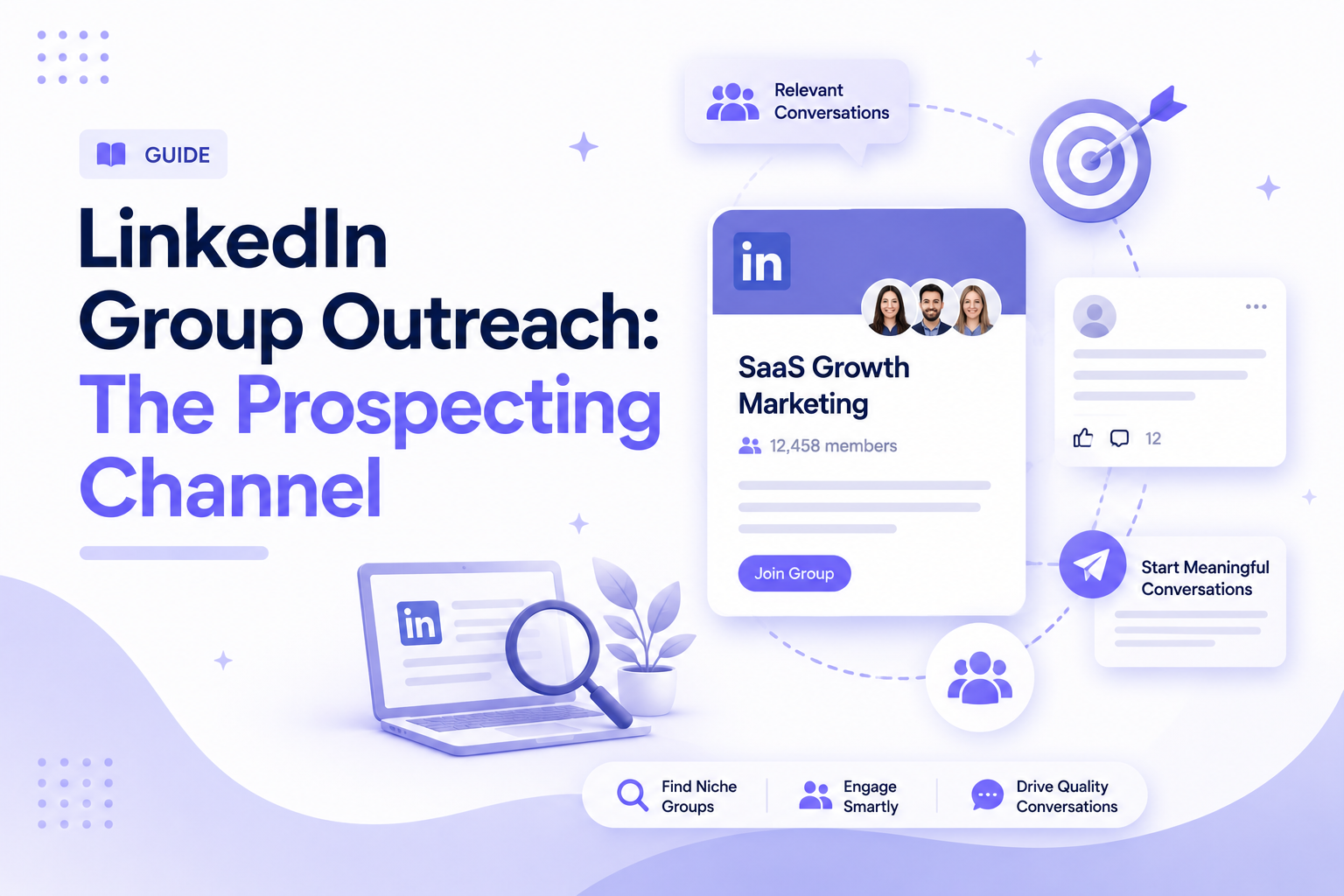
LinkedIn Group outreach is the practice of using LinkedIn Groups to find, qualify, and reach outbound prospects. In 2026, the highest-leverage play is not sending direct messages to fellow group members (which LinkedIn caps at 10 per week and routes to Notifications instead of the main inbox), but using group membership as a targeting filter to build higher-signal prospecting lists than any Boolean search can produce. Groups are self-selected ICPs: a member of "Senior CFOs Network" has told you their role, seniority, and topic interest in one signal. That's a precision Sales Navigator's own filters cannot match. Everyone talks about groups as a messaging shortcut. The real value is upstream, in who you target and why.
This piece walks through the actual mechanics of group outreach in 2026, why the "free message" tactic is a small side play and not the main event, and the five-step playbook to make groups your highest-signal prospecting channel.
Why the "message group members directly" framing misses the point
If you've read anything about LinkedIn Groups for outbound, you've probably read the same claim: you can message any fellow group member without connecting first, so groups are a way to bypass connection request limits. This is technically true and practically overrated.
Here's what actually happens when you use the group message workflow in 2026:
- You have to wait three days after joining a group before you can send any free messages to other members
- Free group messages count as "message requests," which LinkedIn caps at roughly 10 per week per account
- Group-sent messages route to the recipient's Notifications tab, not their main Messages inbox, which means lower visibility and lower reply rates than a normal DM
- Many group members have "Allow members to message me" turned off, so the ability quietly fails
Ten messages per week, delayed by three days, routing to the notifications tab, with a partial success rate, is not a scaling channel. It's a niche play for very high-value prospects on very short lists.
The framing that most content misses: the messaging path is a nice-to-have. Group membership as a targeting filter is the real prospecting engine.
Why groups are the highest-signal ICP filter LinkedIn has
Every outbound team defines an ICP: industry, company size, role, seniority. Then they translate that ICP into Sales Navigator filters and hope the resulting list is close to what they actually wanted.
The gap between "what you defined" and "who Sales Navigator returns" is where most prospecting time gets wasted. Someone with "Head of Growth" in their headline could be doing paid ads at a Series B, or running SEO at a bootstrapped agency, or holding a title that's essentially individual contributor at a 20-person company. The role filter can't tell them apart.
Group membership is different. Someone in "SaaS Growth Marketing" has actively self-selected into a room labeled with your ICP topic. They've told you:
- They're interested enough in the topic to join a professional group about it
- They likely hold a role where the topic matters day to day
- They're active on LinkedIn (they joined a group, not just created a profile)
- They see themselves as part of the community you're selling to
That's four ICP signals from one action. No Boolean search filter produces that.
The comparison that matters:
- Sales Nav search returns everyone whose profile fields match your filters. Precision varies wildly.
- Group-filtered search returns everyone whose profile fields match AND who has publicly identified as caring about the topic. Precision compounds.
For a well-chosen group of the right size (see below), acceptance rates and reply rates on group-sourced prospects run materially higher than the same volume from a raw Sales Nav search. Not because the outreach is different but because the underlying list is better.
The 5-step LinkedIn Group prospecting playbook
Step 1: Find the right groups
Not all groups are useful. High-value groups have:
- Between 500 and 25,000 members. Too small and the audience is thin. Too large (like "Software Sales" with 400,000 members) and the signal disappears, most members joined years ago and forgot.
- Recent activity. Look at "Conversations" or the group feed. If the last post is 6 months old, the group is dead, and half the members probably no longer hold the role you care about.
- A specific topic, not a broad one. "CFOs" is too wide. "SaaS CFO Peer Group" is a real ICP. The narrower the topic, the higher the signal per member.
- Some level of moderation. Active groups with visible admins are where real professionals hang out. Ungoverned groups fill with spam and bots.
Find groups three ways. First, search LinkedIn Groups directly for your ICP topic. Second, look at the "Groups" section on the profiles of 5 to 10 customers you already have; the groups they're in are your prospecting shortlist. Third, once you've joined one good group, LinkedIn will surface "similar groups" that are usually well-matched.
Step 2: Join, wait, engage
Once you request to join, the moderator may take a few days to approve you. Do not send a single connection request or message to the group's members during this time. Two reasons: the three-day cooling-off restriction on group messaging exists, and more importantly, showing up as a new member and immediately spamming everyone is the fastest way to get flagged by admins and removed.
In the first week after joining:
- Read the last 20 to 30 posts to understand the group's tone
- Like 3 to 5 posts that resonate
- Leave one thoughtful comment (not a plug) on a recent discussion
- Look at who's posting and who's commenting, these are your active members
This engagement window has a double purpose. It gets you familiar with the group's context (which will show up in your outreach messaging), and it makes you a real member instead of a lurker with a suspicious join pattern.
Step 3: Pull the member list into Sales Navigator
This is where the targeting-filter play unlocks. In Sales Navigator, the Groups filter lets you narrow any search to members of a specific group. Use it as the anchor filter, then layer on your normal ICP filters (job function, seniority, company size, geography).
Example: "Members of the SaaS Growth Marketing group AND Head of Growth OR VP of Marketing AND at companies with 50-500 employees AND in North America." Every result on that search is someone who has passed four signal checks, not just one.
Save this as a Sales Nav search. Refresh it monthly to pull new members who've joined since your last run.
Step 4: Reach out with connection requests, save the group reference for the follow-up
For the vast majority of your outbound, use connection requests, not group messages. Connection requests scale (100/week vs 10/week for group messages), land in the main inbox (not notifications), and don't have the three-day cooling off constraint.
Send the connection request without a note. Data on this consistently favors no note over a note, blank invites convert better because a note makes the request read as a pitch before the person has even accepted. This holds true whether or not you have a group in common. Save the group reference for where it actually earns its keep: the first follow-up message after they accept.
"Hi \[name\], thanks for connecting. Saw we're both in the SaaS Growth Marketing group, been following the discussion on \[specific topic recently discussed in the group\]. \[Your actual reason for reaching out\]."
This is not a template you write once and blast at 100 people. It's a scaffold you personalize per prospect using something specific from their profile or their group activity, sent after acceptance rather than baked into the invite. The group reference still does the work of establishing shared context, it just does it at the moment the person is actually reading a message instead of deciding whether to accept a stranger.
Step 5: Reserve group messaging for the top 10 per week
The 10 free message requests per week are best spent on prospects who are worth the higher-effort outreach: your top-tier accounts, or someone whose connection request has been sitting pending for a week and needs a nudge. Use group messages as a scarce, high-value channel, not as your primary outreach mechanic. Reference the specific group and something the person has posted or commented on inside it.
If the recipient has "Allow members to message me" turned off, the send will silently fail. This is normal. Move to a connection request as the fallback.
What kinds of groups to prioritize (and which to skip)
Prioritize:
- Role-specific peer groups ("Heads of Sales Peer Group", "CTO Roundtable")
- Industry vertical groups tied to a specific job function ("SaaS Customer Success", "Fintech Product Managers")
- Certification or training alumni groups (people who paid to be there = high signal)
- Regional professional networks for your target market
Skip:
- Broad "professionals in \[industry\]" groups (too diluted)
- "Networking" or "connect with me" groups (mostly other salespeople and recruiters)
- Groups where the last post is more than 2 months old
- Groups with obvious bot or spam presence in the feed
- Groups explicitly branded around outbound sales, unless you sell to sales teams
The prioritize list is where your ICP self-identifies. The skip list is where everybody's ICP goes to hide.
How OutFlo handles group-sourced prospecting
The workflow above ends with a Sales Navigator search filtered by group membership. From there, the coordination work OutFlo handles:
Sales Navigator to campaign import. Paste a Sales Nav search URL (or a saved list URL) directly into OutFlo, and the leads land in a lead list ready for a campaign. No CSV export, no manual mapping. For group-filtered searches specifically, this means the "high-signal group → campaign" pipeline is one paste, not a multi-step export.
AI Personalization that reads the group context. OutFlo's AI Personalization reads each prospect's profile and recent activity. Send the connection request blank, no note, then let AI Personalization draft the follow-up once they've accepted, referencing the shared group and something specific from their activity. So 30 accepted connections can carry 30 distinct group-referenced opening messages without you writing each one by hand.
Unified Smart Inbox for the resulting conversations. Group-sourced prospects convert at higher acceptance rates than cold Sales Nav lists, which means more conversations to manage. The unified inbox auto-tags replies (Interested, Not Interested, Generic) and lets you filter by "Needs My Reply" to work the resulting queue in one view, across multiple sender accounts if you're running the same play from more than one profile.
The combination lets you run group-sourced outbound as a repeatable engine instead of a manual, one-off experiment.
FAQ
Common questions
How many LinkedIn Groups can I join, and does joining a lot hurt my account?
LinkedIn caps membership at 100 groups per profile. Joining aggressively (10 in a day) can trigger safety flags, so space it out (2 to 3 groups per week) especially on a newer account. For prospecting purposes, 15 to 25 well-chosen groups covers a broad ICP without spreading you thin. Prioritize being active in 5 or 6 of those, and use the rest as targeting-filter sources through Sales Nav.
Can I send LinkedIn group messages using an outreach automation tool?
Some tools support it, but the underlying LinkedIn cap (10 message requests per week per account) applies regardless of tool. Automating group messages does not raise the ceiling, it just makes the 10 sends easier to execute. Given the constraints (three-day wait, notifications-tab routing, per-recipient opt-in required), most operators find the ROI on automating group messages is lower than on automating the connection request plus group-referenced follow-up sequence. Use group messaging as the manual, high-touch play. Automate the no-note connection request and follow-up sequence instead.
Does the Groups filter in Sales Navigator work with free LinkedIn accounts?
The Groups filter is a Sales Navigator feature, not free LinkedIn. If you don't have Sales Nav, you can still find group members by opening the group directly and browsing the member list, but you can't layer additional filters (role, seniority, company size) on top. The full targeting-filter play (groups AND job function AND company size) requires Sales Nav to be usable at scale. For teams running serious LinkedIn outbound, Sales Nav pays for itself against this workflow alone.
Is it against LinkedIn's terms of service to use groups this way?
Joining groups, engaging with content, and sending connection requests to fellow members are all standard LinkedIn use, whether or not you reference the group. Using group membership as a Sales Nav targeting filter is also standard, since Sales Nav ships that filter. What LinkedIn's terms discourage is scraping group member lists with unauthorized tools, sending high-volume unsolicited messages to group members, and using automation that misrepresents itself as human activity. The playbook above stays inside the platform's intended use of groups.
How is this different from just posting in the group and hoping for replies?
Very different. Posting in the group is inbound: you publish, wait for the right person to see it, hope they engage. That works over months if the posting is consistent and the group is active, but it's slow and its results depend heavily on LinkedIn's feed algorithm. Group-filtered outbound is direct: you use the group as an ICP signal, then reach out proactively. Best practice is to do both. Post occasionally to build presence in the group (which lifts your reply rate when you do reach out), and do the outbound as the primary pipeline mechanic.