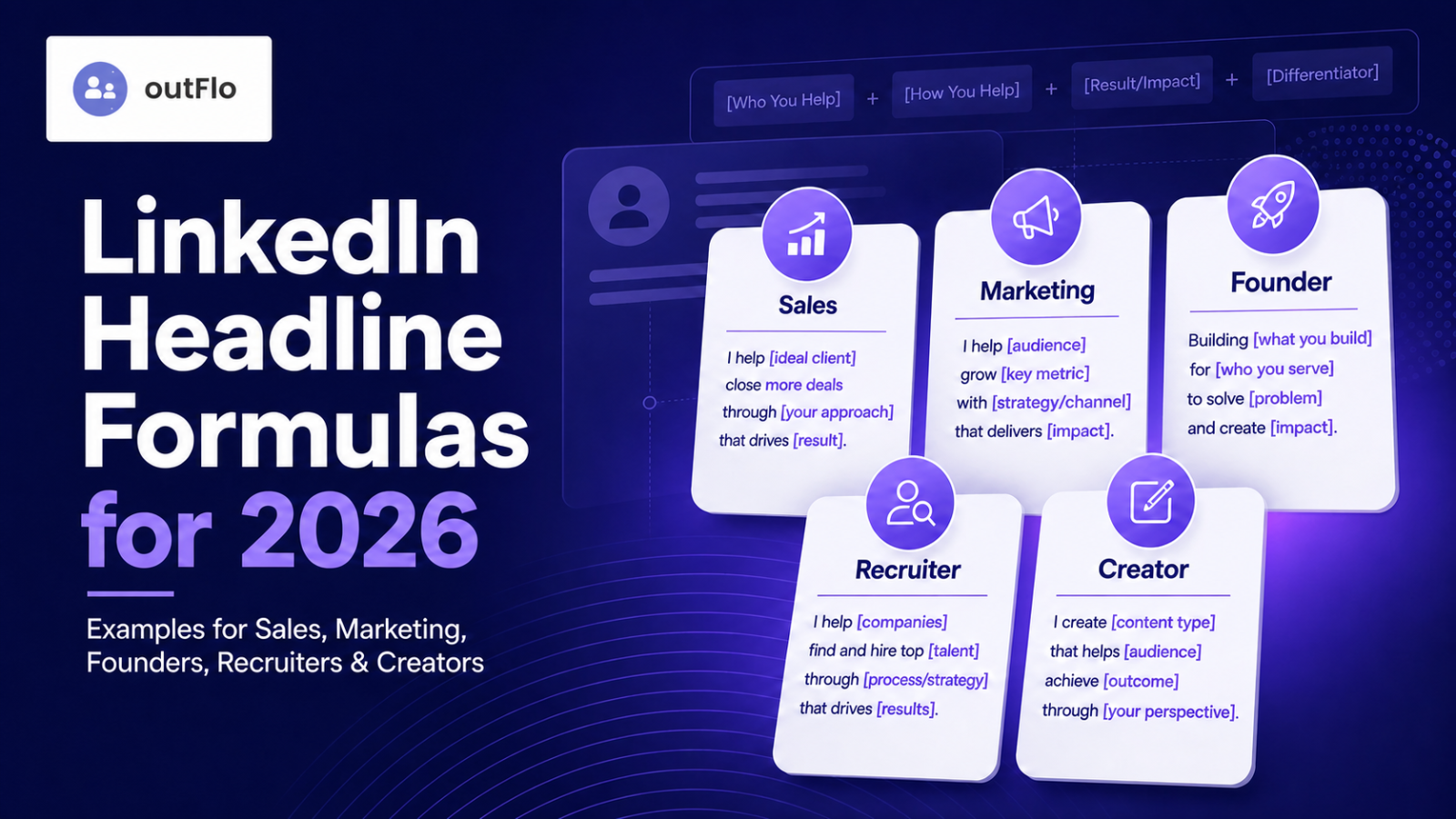
Your LinkedIn headline should say your role, who you help, the outcome you deliver, and a proof point, in that order of priority, inside 220 characters. It appears under your name in search, comments, connection requests, and DMs, so it is the single most-seen line on your profile. Most people still leave it as "Job Title at Company," which wastes the most valuable text real estate LinkedIn gives you. This guide covers the current character limits, the elements that actually work in 2026, five plug-in formulas, examples by profession you can adapt today, and the mistakes that quietly cost you clicks.
Why the headline carries so much weight
LinkedIn search behaves a lot like Google. The headline is one of the most heavily weighted fields for ranking in recruiter searches and Sales Navigator filters, so if it does not contain the words people search for, you do not appear. That alone makes it worth more than most people give it.
Beyond search, it is a conversion trigger. Someone sees your comment on a post, glances at your headline, and decides in about two seconds whether to click your profile. A vague headline loses that click before your profile ever gets a chance. The headline works even when you are not posting, following you into every feed, comment, and search result you show up in.
The character limit, and the part that actually shows
As of 2026, the LinkedIn headline limit is 220 characters on desktop and up to 240 on mobile. That is the ceiling, not the target.
The number that matters more is how much shows before truncation. In search results, comments, and connection suggestions, only around 70 characters display on mobile and roughly 120 on desktop. So even with 220 characters to work with, the first 70 have to carry your identity and your most important keyword. Everything after that adds detail and search keywords that help you rank, even though many people never scroll to read it.
The practical rule: front-load. Put your role and your single most valuable keyword in the opening, and treat the back half as keyword and context space.
What to put in your headline: the core elements
Across high-performing 2026 profiles, four elements do the work. You do not need all four every time, but the strongest headlines combine at least three.
Role or target role. Always include an industry-standard job title. "Growth Marketer" beats "Revenue Alchemist" because recruiters and buyers actually search the former. Clarity ranks; cleverness does not.
Who you help. Name your audience or niche. "B2B SaaS startups" or "mid-market HR teams" tells the reader in a glance whether you are relevant to them.
Value or outcome. State what people get. "Turn signups into paid users" or "reduce churn by 30 percent" is concrete and memorable in a way a title is not.
Proof or keywords. Certifications, tools, notable clients, or hard skills. "Python, SQL, Tableau" or "Ex-Stripe" adds credibility and doubles as searchable terms.
Five headline formulas that work in 2026
Formulas make this fast. Pick the one that matches your goal and fill in the blanks.
Formula 1, Role plus Who You Help plus Outcome. The classic value-based structure. Example: Product Manager | Building AI tools for SMBs | 0 to 1 specialist
Formula 2, Job Title plus Key Skills plus Industry. Best for ranking in recruiter searches. Example: Senior Data Analyst | Python, SQL, Tableau | E-commerce focus
Formula 3, Role at Context plus Specialization plus Metric. Strong when you have a specific result. Example: Growth Marketer @ Series A startup | Paid social and CRO | 3x MQLs in 12 months
Formula 4, Target Title plus Core Skills plus Open to X. Built for active job seekers. Example: Junior UX Designer | Figma, User Research, Prototyping | Open to remote roles
Formula 5, Service for Audience plus Main Outcome plus Proof. Best for freelancers and consultants. Example: Email Copywriter for DTC brands | Turn subscribers into buyers | Worked with 10+ startups
Examples by profession
Adapt these to your own specifics rather than copying them outright, since the proof points are what make them land.
Software engineers. Full-Stack Developer | React, Node.js, TypeScript, AWS | Building scalable SaaS products or Backend Engineer | Go, Kubernetes, PostgreSQL | Helping fintech startups ship faster
Marketers. Demand Gen Manager | B2B SaaS | Grew pipeline from $2M to $8M in 18 months or Content Strategist | SEO and thought leadership for tech founders | Ex-HubSpot
Sales professionals. B2B SaaS AE | Mid-market | $1.5M ARR closed in 2025 or SDR | Outbound specialist | Booking 40+ qualified meetings monthly
Product managers. Product Manager | AI-powered B2B tools | Ex-Stripe, 0 to 1 focused or Senior PM | Healthtech | Shipped features used by 2M+ patients
Career changers. Ex-Teacher turned Instructional Designer | Learning Experience Design, Storyline 360 or Transitioning from Finance to Product | Certified Scrum Master | Data-driven mindset
Freelancers and consultants. Freelance UX Writer for SaaS | Turn signups into paid users | 10+ startup clients or LinkedIn Ghostwriter | B2B founders and VPs | Turn expertise into inbound leads
Students and entry-level. Aspiring Data Scientist | Python, SQL, Pandas | Built ML projects on Kaggle or Recent Marketing Grad | SEO, Google Analytics, HubSpot | Looking for growth roles
What not to put in your headline
Some choices actively cost you. Avoid these.
Buzzwords without substance. "Passionate thought leader" says nothing. Replace it with what you actually do.
Made-up titles. "Chief Happiness Officer" or "Revenue Alchemist" might feel fun, but nobody searches for them, so you vanish from results.
Only "Job Title at Company." This is the default LinkedIn fills in for you. It is the bare minimum and gives no reason to care.
Generic soft skills. "Team player, hard worker, dedicated" belongs to 2010. Recruiters filter by hard skills and tools, not personality traits.
Cleverness at the expense of clarity. If someone needs more than two seconds to work out what you do, you have lost them. A playful line only works once the clarity is already there.
How to optimize for search and recruiters
If you want to be found, treat the headline like an SEO field.
Use standard job titles, the exact terms people search, rather than invented ones. Include hard skills and tools for technical roles, since "Python, SQL, Tableau" and "Salesforce, HubSpot, Marketo" are all searchable. Add your industry or niche, because "fintech," "healthtech," and "B2B SaaS" are keywords people filter by. And front-load the important terms, because only the first 70 to 120 characters show in most contexts.
Copy-ready templates
Fill in the blanks and test one for a week.
- \[Your Role\] | Helping \[Audience\] \[Achieve Outcome\] | \[Proof or Credential\]
- \[Target Job Title\] | \[Skill 1, Skill 2, Skill 3\] | \[Industry\] | Open to \[Location/Remote\]
- \[Role\] @ \[Company/Context\] | \[Specialization\] | \[Specific Result or Metric\]
- \[Service\] for \[Audience\] | \[Main Outcome\] | \[Notable Client or Credential\]
- Ex-\[Previous Role\] now \[Current Role\] | \[Bridge Skills\] | \[What You Bring\]
Why this matters more if you run outreach
Here is the part most headline guides skip. If you send connection requests or messages on LinkedIn, your headline is doing sales work before your message is even read. A prospect sees your name and headline attached to every invite and DM, and decides in that glance whether you are a peer worth hearing from or a salesperson to ignore.
A headline that reads "SDR at Acme, hitting quota" frames you as someone about to pitch. A headline that frames you as an expert who helps their exact situation, "Helping B2B SaaS teams book more meetings without more headcount," earns the open. Same person, very different response rate, and the message has not even been read yet. If you are doing outreach at any real volume, the headline is not a personal-branding afterthought. It is the first line of your outreach.
This is where OutFlo fits, at the layer after the headline. OutFlo runs LinkedIn outreach across your team's real accounts from one workspace, with AI personalization written from each prospect's live profile and a unified inbox that pulls every reply into one place. It does not write your headline for you, that is your positioning to own, but it is built on the same principle: outreach works when the person behind it reads as relevant and credible, at every touch, at scale.
Start your free OutFlo trial · 8-day free trial, no credit card, connect an account in about a minute.
The bottom line
Your headline is a small piece of real estate with outsized impact: a search ranking factor, a two-second conversion trigger, and your positioning statement in one line. Include your role, who you help, the outcome you deliver, and proof you can do it. Use standard titles and hard skills so you rank, front-load the first 70 characters for mobile, and update it whenever your goal shifts. Write it like someone is deciding in two seconds whether you are worth a click, because they are.
8-day free trial · No LinkedIn password · One-minute setup
FAQ
Common questions
What is the LinkedIn headline character limit in 2026?
The LinkedIn headline limit is 220 characters on desktop and up to 240 on mobile. But only about 70 characters show on mobile and around 120 on desktop in search results, comments, and connection suggestions, so front-load your role and most important keyword in the first 70 characters.
What should I put in my LinkedIn headline?
Four elements do the work: your role or target role using a standard job title, who you help, the outcome you deliver, and a proof point like a tool, certification, or notable result. You don't need all four every time, but the strongest headlines combine at least three, with the most important keyword placed first.
What is a good LinkedIn headline formula?
A reliable one is: Role plus Who You Help plus Outcome, for example "Product Manager | Building AI tools for SMBs | 0 to 1 specialist." For recruiter search, use Job Title plus Key Skills plus Industry, for example "Senior Data Analyst | Python, SQL, Tableau | E-commerce focus." Pick the formula that matches your current goal and fill in the blanks.
What should you not put in a LinkedIn headline?
Avoid buzzwords without substance like "passionate thought leader," made-up titles like "Revenue Alchemist" that nobody searches for, the bare "Job Title at Company" default, and generic soft skills like "team player." Also avoid cleverness that sacrifices clarity, since a reader who needs more than two seconds to understand what you do will move on.
Can I use emojis in my LinkedIn headline?
Yes, but sparingly. One or two relevant emojis or separators can add visual structure and help your headline stand out. A headline crowded with emojis looks cluttered and unprofessional, and each emoji also consumes characters against your 220 limit, so use them only where they add clarity.