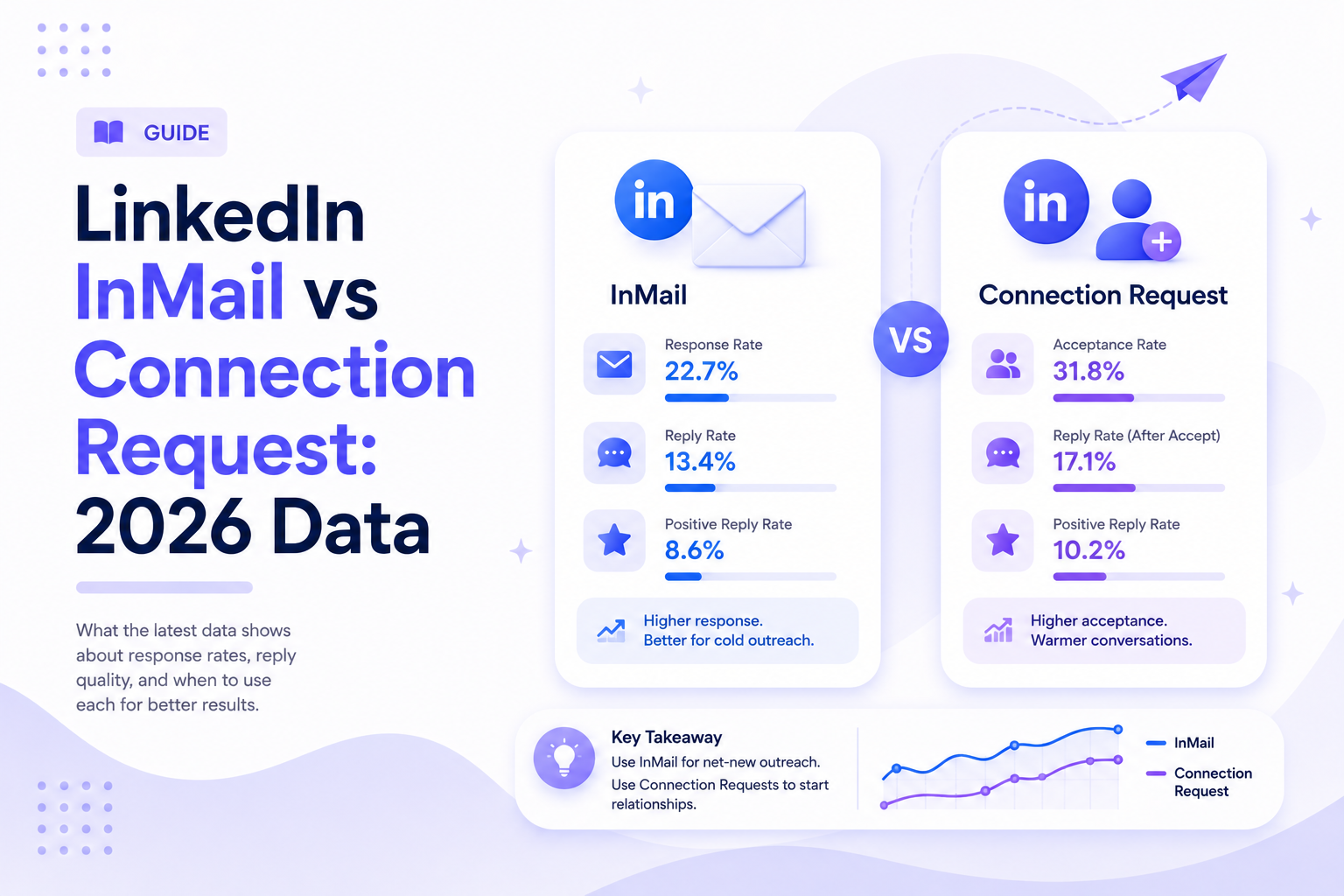
For most B2B outreach in 2026, connection requests convert better than InMail, but not for the reason people usually give. Per message sent, InMail replies at 10 to 25 percent and a connection request with a note replies at roughly 9 percent. Per sender seat per month, connection requests produce three to six times more conversations, because one Sales Navigator seat gets 50 InMail credits and roughly 350 connection requests over the same period.
The debate is usually framed as a quality question. InMail is the premium channel, it lands in the inbox and the email inbox, it carries a subject line, so it must convert better. Per message, that framing holds up. The problem is that nobody runs outreach one message at a time, and the moment you look at a month of sending capacity, the ranking flips.
The per-message numbers, honestly stated
InMail wins this comparison, and pretending otherwise is how outreach content loses credibility.
LinkedIn's own reported benchmarks put InMail response rates at 10 to 25 percent, with strong performers landing between 30 and 40 percent. Belkins' 2025 B2B outreach study found InMail campaigns produced the highest overall response rate of any campaign type they measured, at 6.38 percent, with every reply arriving on the first message rather than a follow-up.
Connection requests look weaker on the same axis. Expandi's analysis of over 20 million LinkedIn outreach attempts puts average connection acceptance at 29.61 percent. Of the people who accept, 9.36 percent reply when the request carried a note, and 5.44 percent reply when it did not.
So a single InMail beats a single connection request. That is the correct read of the per-message data, and it is why the "premium" framing has survived this long.
Where the premium framing breaks
InMail is metered. Connection requests are not.
Sales Navigator Core costs $119.99 per month in 2026, up from $99.99 the year before, and includes 50 InMail credits. Advanced runs $159.99. Unused credits roll over, capped at 150 on Sales Navigator, so the ceiling on a single seat is real and low. Sales Navigator users cannot buy additional credits.
Connection requests carry no credit cost at all. Most accounts in good standing send 80 to 100 per week safely, which puts a single account somewhere around 350 per month. High-trust accounts with a strong SSI score and acceptance above 40 percent go higher.
Run both through a month on one seat.
InMail. 50 sends at a 10 to 25 percent reply rate produces 5 to 12 replies.
Connection requests. 350 sends at 29.61 percent acceptance produces roughly 104 new connections. At the 9.36 percent reply rate for requests sent with a note, that is about 33 replies, before you send a single follow-up message to the other 71 people who accepted and stayed quiet.
Three to six times the conversations, from the channel that loses on every per-message benchmark. The gap is not about message quality. It is about how many times you are allowed to try.
The compounding asset nobody prices in
An InMail reply is a conversation. A connection acceptance is a conversation plus permanent, unmetered access to that person's primary inbox.
Every message you send that prospect after acceptance costs nothing and needs no credit. It also lands as a first-degree message rather than a cold InMail, which is a different psychological object for the recipient. Direct messages to first-degree connections benchmark at 25 to 35 percent reply rates with personalization, roughly double cold InMail.
Those 71 people who accepted and did not reply are not a loss. They are a list you can message next quarter when your positioning changes, or when they change jobs.
The connection note finding that contradicts standard advice
Standard advice says personalize your connection note so more people accept. The data does not support it.
Across Expandi's 20 million-plus attempts, requests with a note were accepted 26.42 percent of the time. Requests without a note were accepted 26.37 percent of the time. A five-hundredth of a percentage point. The note does nothing for acceptance, essentially.
What it does do is change what happens next. Reply rate goes from 5.44 percent without a note to 9.36 percent with one, close to a doubling. Some operators report the opposite pattern on acceptance specifically, with blank requests to well-targeted prospects outperforming templated notes, which is consistent with the underlying mechanism: a bad note actively hurts, a blank request is neutral, and a genuinely relevant note pays off after acceptance rather than at the accept decision.
The practical version. Write the note for the conversation, not the acceptance. If you cannot write something specific to that person, send it blank and put the effort into the first message after they accept.
When InMail is the right call
Volume math does not mean you should never send an InMail. Four situations where it earns the credit.
Open Profiles. Sales Navigator users can InMail any Premium member with Open Profile enabled without spending a credit. This removes the entire cost argument. Filtering for Open Profiles first, then InMailing them, is close to free reach.
Senior executives who do not accept requests. A VP with 400 pending invitations is not going to see yours. An InMail with a subject line lands in the inbox and mirrors to their email.
Refundable sends. InMails that get a response within 90 days are credited back. On a tightly targeted list where you expect a high reply rate, the effective cost per InMail is well below the headline rate.
New or cold accounts. An account under six months old sees lower acceptance rates because LinkedIn throttles it and prospects distrust thin profiles. If you cannot yet send 350 requests a month safely, the volume advantage is not available to you.
The multichannel version beats both
The teams reporting 15 to 25 percent reply rates are not choosing. They run connection request day one, email day three, LinkedIn message day seven, email follow-up day ten.
Two adjacent findings support layering rather than picking. Campaigns that pair a direct message with an additional action such as a profile visit reach reply rates up to 11.87 percent, against 9.36 percent for the message alone. Sequenced follow-ups spaced two to five business days apart improve conversions by 49 percent over one-off messages, and 48 percent of reps never send a second message at all.
The honest conclusion is not that connection requests beat InMail. It is that your sequence should default to connection requests for the volume, hold InMail credits for the accounts where a request will not land, and put most of the effort into the follow-ups after acceptance where the replies actually cluster.
Running both channels without running two systems
The reason most teams pick one is operational, not strategic. Testing connection requests against InMail on the same audience means running two lists, tracking two sets of numbers, and reconciling replies across separate inboxes. That work is what gets skipped under volume, so the test never happens and the default becomes whatever the team did last quarter.
OutFlo's campaign builder treats both as action types in the same sequence. Connection requests, messages, InMails, post likes, and profile views are all steps you can place, which means an A/B between the two is a difference of one step in a campaign rather than a difference of two workflows.
Smart Sequences branch on what actually happened rather than a fixed timer. Connection accepted, profile view registered, message read: each becomes a condition that routes the prospect down a different path. The practical use here is an InMail fallback. Send the connection request first, and if it has not been accepted after a set window, spend a credit on the same prospect instead of writing them off. The 50 credits go to the accounts where the free channel already failed, which is the highest-value place to spend them.
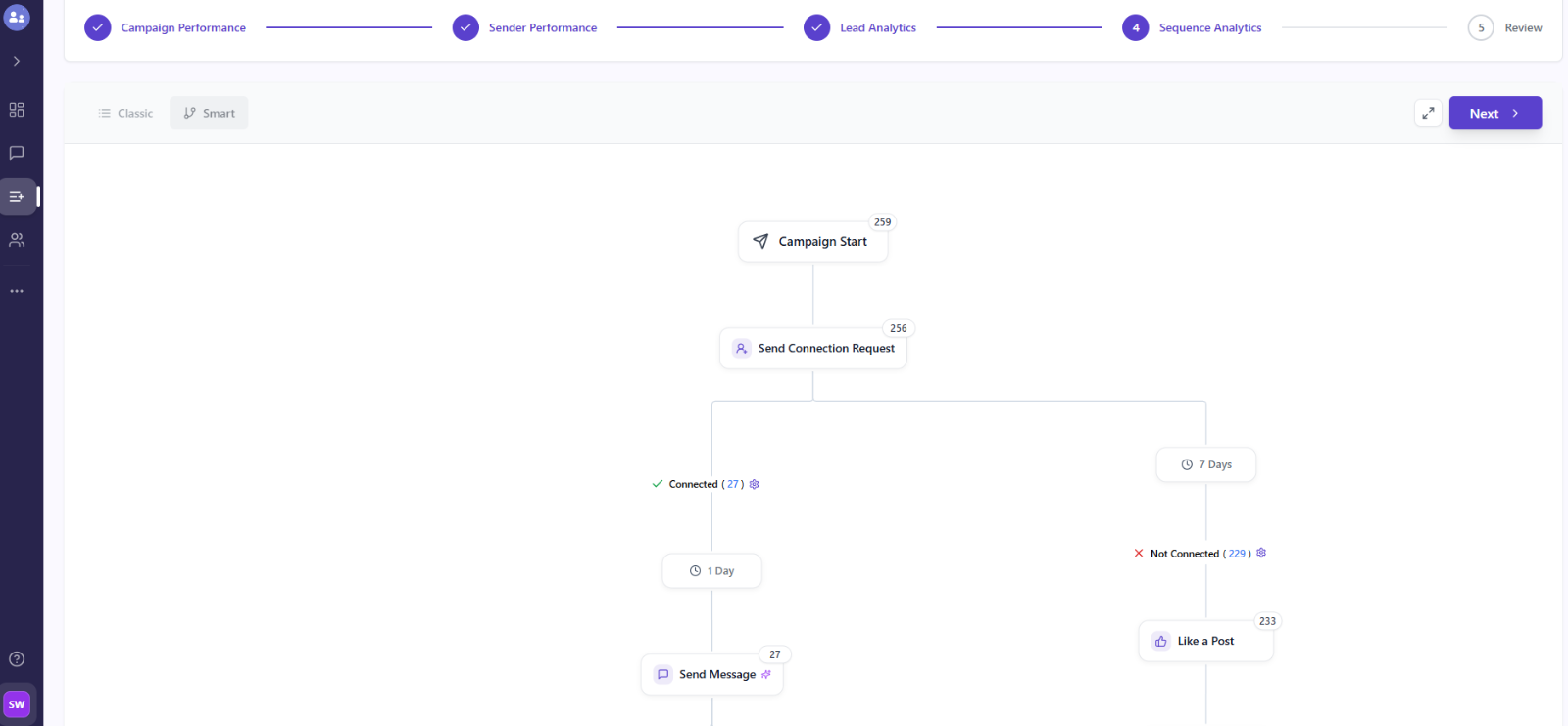
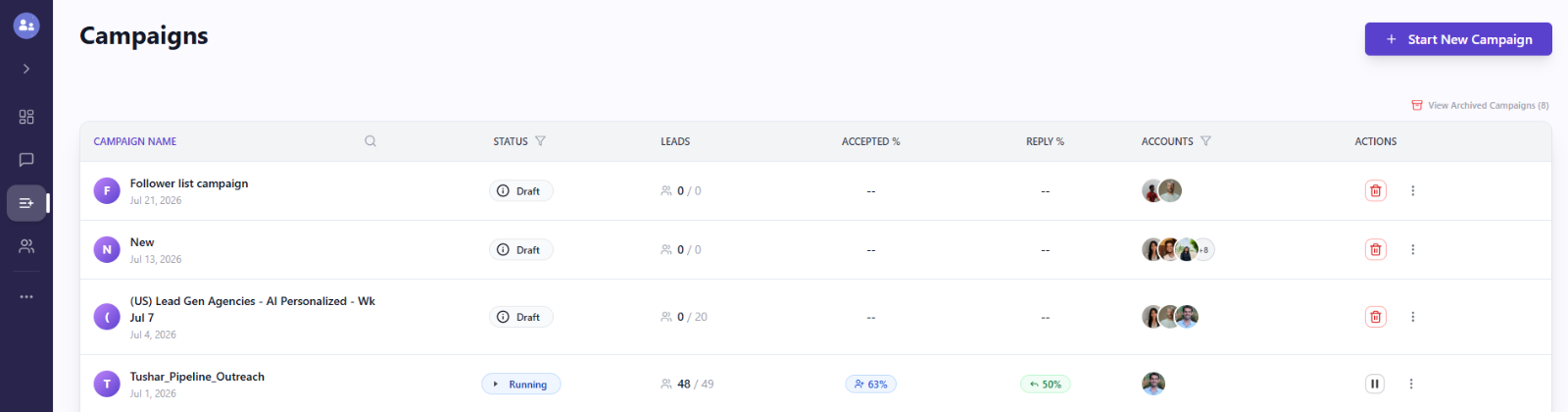
Multi-Account Campaigns deal with the capacity ceiling. One seat is capped near 350 connection requests a month. Four sender accounts running the same campaign, each with its own daily limits and its own allocated slice of quota, move the ceiling without pushing any single account past what LinkedIn tolerates. Per-account daily caps and Smart Auto-Increase handle the warm-up so newer accounts scale as they earn trust rather than getting throttled on day one.
FAQ
Common questions
Is InMail worth the Sales Navigator subscription if connection requests are free?
Sales Navigator is worth it for the search filters, lead lists, and freshness of role data, more than for the 50 credits. If InMail is the only reason you are considering it, the math is hard to justify at $119.99 per month for 5 to 12 expected replies. Teams selling $5,000 plus deals into mid-market B2B generally clear the bar. Teams selling under $3,000 into SMBs usually do not.
Do InMail credits actually get refunded?
Yes, if the recipient responds within 90 days. This meaningfully lowers effective cost on well-targeted lists, and it is the strongest argument for reserving credits for prospects you have already researched rather than spraying them across a cold list.
Should I send connection requests with or without a note?
Send a note if it is specific to that person. Acceptance rate barely moves either way, at 26.42 percent with versus 26.37 percent without, but a relevant note nearly doubles the reply rate after acceptance. A generic templated note is worse than nothing, so send blank rather than send filler.
How many connection requests can I send per week without getting restricted?
Most accounts handle 80 to 100 per week. Accounts with high SSI and acceptance rates above 40 percent can push toward 200. Watch acceptance rate as the safety signal: below 20 percent, LinkedIn starts restricting accounts, which means a targeting problem becomes a deliverability problem quickly.
Is the three to six times figure true for every industry?
No. It is a capacity ratio built from average acceptance and reply rates, and both vary widely. Legal and professional services see reply rates around 10.42 percent while software and SaaS sit near 4.77 percent, which is the lowest of any sector measured. In a low-acceptance vertical selling to senior buyers who ignore invitations, the InMail gap narrows and can close. Run the same math on your own acceptance rate before assuming the ratio holds.