The Model Context Protocol (MCP) is a connection standard that lets an AI assistant like Claude read from and write to your LinkedIn outreach tool through a defined set of actions. In practice, that means Claude can pull your lead lists, inspect a campaign's status, and draft a reply into your inbox from natural language. What MCP does not do is autonomously run cold outreach at scale. It is a lens and a drafting layer on top of the outreach platform, not a replacement for the platform itself. The distinction matters because most content about "AI outreach" quietly conflates the two, and teams end up disappointed when Claude does not magically send 500 connection requests overnight.
This article walks through what actually works today when you point Claude at a LinkedIn outreach stack over MCP, where the real time savings are, and where the pitch outruns the product. If you have been reading about Claude Code plus LinkedIn automation and wondering what is real, this is the honest version.
Why the "Claude runs your outbound" framing is misleading
The popular version of the story goes like this: you install an MCP server, point Claude at it, and Claude becomes an autonomous SDR that finds leads, writes personalized messages, and hits send while you sleep.
Every one of those verbs deserves scrutiny.
Find leads. Claude can call an MCP action that reads leads from a list you already have. It does not source leads from a cold universe on its own. Sourcing still happens in Sales Navigator, in Apollo, in Clay, or via a LinkedIn search you pasted in. Claude's job is downstream of the source.
Write messages. This part is genuinely strong. Claude reads a prospect's profile, their recent activity, and your value proposition, and drafts a message that is materially better than a mail-merge template. This is where MCP earns its keep.
Hit send. This is where the pitch breaks. LinkedIn rate limits, per-account daily caps, warm-up ramps, and safety pacing all live in the outreach platform, not in Claude. When Claude "sends" a message via MCP, it submits it to the outreach tool's queue, and the tool decides when to push it to LinkedIn based on the account's warmup state and daily budget. Claude is a client, the outreach platform is the server that owns the send.
If you strip out the marketing gloss, MCP for LinkedIn outreach is a natural-language interface to a system that already existed. That is a real productivity win. It is not autonomy.
What Claude and MCP actually do well today
Four workflows account for almost all the leverage.
1\. Reply triage and drafted responses at scale. When you run outreach across five or ten LinkedIn accounts, replies pile up faster than any single operator can review. Claude, connected over MCP, can read your unified inbox, classify replies by intent, surface the ones that need a human right now, and draft a reply for each. You approve or edit before sending. This is the single highest-leverage use case today.
2\. Ad-hoc lead inspection in natural language. Instead of clicking through the UI, you ask Claude: "Show me every lead in the July SaaS founders list who accepted my connection request in the last 5 days but hasn't replied yet." Claude calls the MCP action, pulls the list, and returns it. What used to be four filter clicks becomes one sentence.
3\. Personalization for high-value accounts. For your top 50 prospects, generic templates lose money. Claude can read each prospect's profile and recent posts, cross-reference your ICP notes, and draft an opener that references something real. You get closer to the quality of a founder-written message without spending 15 minutes per prospect writing it.
4\. Campaign status checks and reporting from chat. "How did the CFO campaign perform last week?" Claude calls the MCP action, pulls the numbers, and summarizes. Useful for anyone who lives in a chat window and wants status without opening a dashboard.
Notice what these four have in common: Claude reads state, drafts content, and hands off to a human or to the outreach platform. It does not run the send loop.
What MCP does not do (and probably will not do soon)
Being clear-eyed about this section is the whole point of the article.
MCP does not warm up your LinkedIn accounts. Warmup is a multi-week ramp of connection requests, messages, and daily activity that the outreach platform manages. No MCP action changes that.
MCP does not bypass LinkedIn's rate limits. Anyone selling you an "AI SDR that sends unlimited messages" is describing a fast way to get accounts restricted. Rate limits are enforced by LinkedIn, honored by the outreach tool, and nothing on the Claude side changes them.
MCP does not source leads from scratch. It reads from lists you already built. If your sourcing pipeline is broken, no amount of Claude will fix it.
MCP does not replace the send infrastructure. The queue, the pacing logic, the safety checks, the sender rotation, the campaign allocation, all of that still runs in the outreach platform. Claude is a way to talk to that infrastructure, not a way to replace it.
The honest reframe: MCP is not an AI SDR. It is a natural-language interface to a stack that a human still owns.
A quick note on why this matters for setup effort
Lemlist recently published a piece pointing out that the "work before the work" in outbound, pulling lists, writing sequences, staging campaigns, is where sales teams silently lose hours every week. That is exactly the layer MCP compresses. It does not automate the outbound. It automates the pre-outbound and the post-outbound. The middle layer, the actual sending, stays where it always was.
If you evaluate MCP against that frame, the ROI math gets clean. You are not paying for an AI SDR. You are paying to reclaim the operator hours spent on setup, list pulls, reply triage, and reporting. Those hours are real, and they are the same hours HeyReach, Lemlist, and now OutFlo are all racing to give back.
How OutFlo's MCP handles this
OutFlo runs an MCP server that Claude can connect to directly. Once connected, Claude gets read and write access to the four surfaces most teams actually touch: Lead Management (list pulls, filtering, adding leads to lists), the Unified Smart Inbox (reading replies, drafting responses into the same shared draft field a human teammate would use), Campaigns (checking status, campaign allocation, sender assignments), and Dashboard metrics.
The design choice worth calling out: when Claude drafts a reply, it lands in Unibox as a purple Draft: under the lead's name, the same place a human draft lands. A teammate can open it, edit, and send. That means Claude does not sit outside your workflow, it plugs into the exact review loop you already use. Every OutFlo feature that closes the reply loop, the shared Drafts, the Interested / Not Interested / Generic auto-tagging, the Needs My Reply filter, works the same way whether the draft came from Claude or from a human.
You can find the integrations page after clicking on the profile button on the bottom right of your OutFlo page, then go ahead and click on Connect with MCP to land at this page:
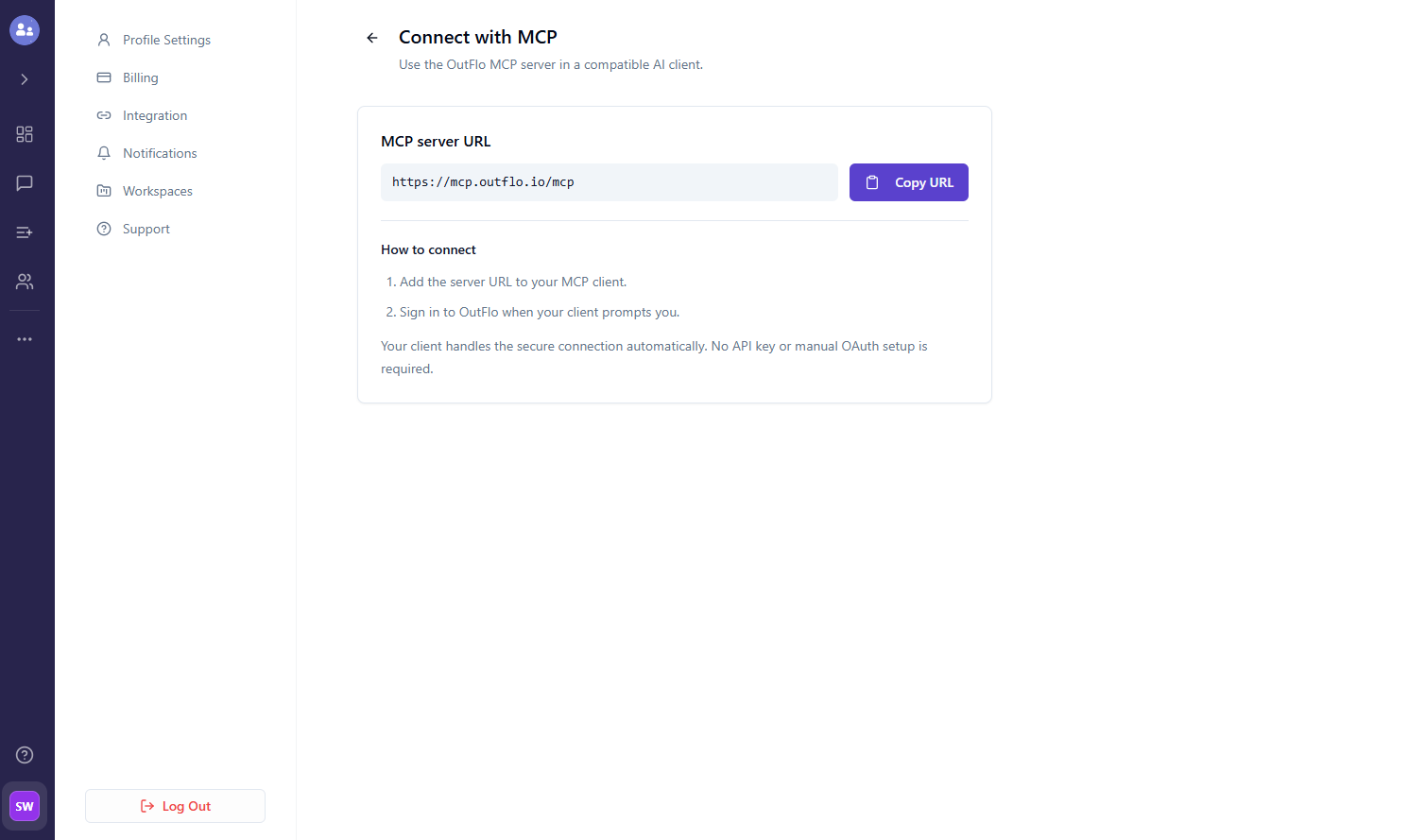
The MCP is available on every OutFlo plan, not gated behind an enterprise tier.
FAQ
Common questions
Do I need Claude Code to use MCP for LinkedIn outreach, or does the Claude chat app work?
Either works. Claude Code is useful when you want to script multi-step workflows against the MCP, for example cleaning a CSV, deduplicating against existing leads, and enrolling the survivors in a campaign in one flow. The regular Claude app is enough for the common cases: drafting replies, checking status, running lead inspections in natural language. Start with the chat app and move to Claude Code once you find yourself running the same sequence of prompts more than three times.
Is MCP-based LinkedIn outreach safe for account health?
It is exactly as safe as your underlying outreach platform, because Claude does not touch LinkedIn directly. Every action Claude takes routes through the outreach tool, which enforces the daily limits, warmup ramps, and pacing that keep accounts in good standing. If your platform is safe, adding MCP does not change the risk. If your platform is unsafe, MCP will not save you.
Can Claude actually send outreach fully autonomously, without me approving each message?
Technically, yes. Practically, no serious operator does this today. The failure modes are asymmetric: one bad message sent to a strategic account is worse than 50 messages that took an extra 30 seconds each to approve. The recommended pattern is Claude drafts, human approves, platform sends. As reply-classification accuracy improves, the human approval on low-stakes replies (a polite "not interested" auto-response) will get automated first. High-stakes replies stay human-approved for the foreseeable future.
How is this different from just using the outreach tool's built-in AI features?
Built-in AI features are constrained to the workflows the vendor designed. MCP is open-ended. You can ask Claude "compare the reply rate on my last three campaigns and tell me what the winning one did differently," and Claude will actually pull the data and answer. That kind of ad-hoc analysis is not something a fixed UI can offer. MCP is worth it when your questions are non-standard.