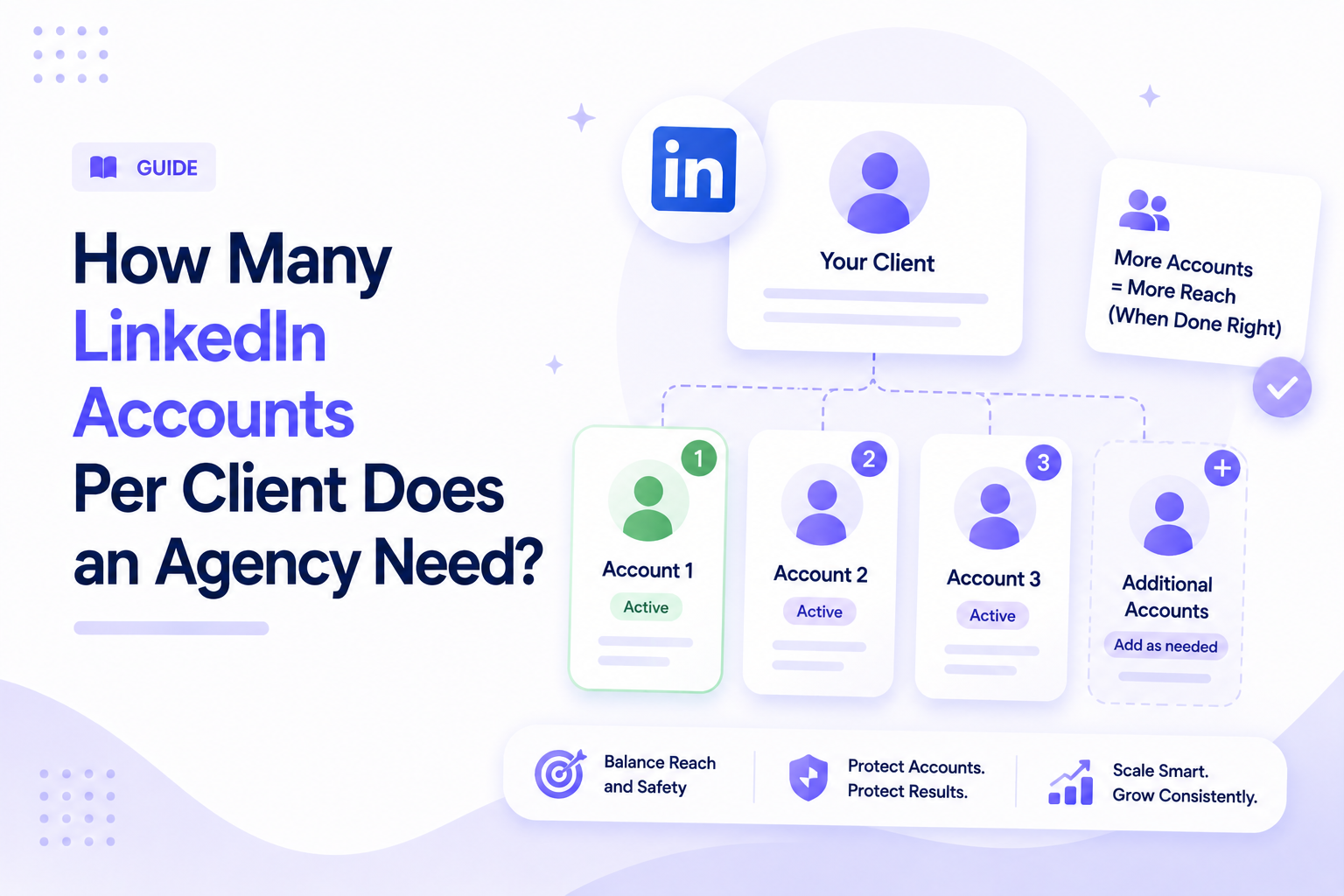
Every client needs a minimum of one dedicated LinkedIn sender account, never shared with another client, regardless of volume. Beyond that floor, account count is a function of target weekly volume divided by what one warmed account can safely send, which in practice is 100 to 200 connection requests per week per account. A client targeting 150 new prospects a week needs one account. A client targeting 600 needs three to four, plus lead time to warm them before they are needed at full capacity.
HeyReach and Aimfox both sell agencies on how many seats they can plug in, unlimited on HeyReach's flat-rate tiers, rented avatars on Aimfox for whatever gap owned accounts leave. Neither answers the question an agency actually has to solve before signing a client: how many accounts does this specific engagement need. Get it wrong low and the campaign stalls against a wall neither the client nor the account manager can see coming. Get it wrong high and you are paying for and warming capacity nobody uses.
Why one account per client is the floor, not a suggestion
The instinct to pool accounts across clients to save on licensing is understandable and it is the wrong call for reasons that have nothing to do with LinkedIn's rate limits.
Overlap risk. Agencies frequently serve clients in adjacent or identical verticals. Run two clients' outreach through the same sender and a prospect can receive two unrelated pitches from what looks, on their end, like the same person. That is not a compliance violation, it is a trust failure the prospect notices immediately, and it surfaces exactly when a lead is good enough to be on more than one client's list.
Identity coherence. A LinkedIn account has a name, a title, a work history. It is implicitly representing one company. An account pitching Client A's product on Monday and Client B's on Wednesday is either visibly inconsistent to anyone who checks the profile, or requires the profile itself to misrepresent whose outreach it is running, which is worse.
Clean handoff. Client relationships end. An account dedicated to one client pauses or gets reassigned cleanly when that engagement does. A pooled account carrying three clients' history cannot be handed back, deactivated, or audited without touching the other two.
Reporting integrity. A client paying for LinkedIn outreach expects to see their own numbers. Sent, accepted, replied, booked, attributable to their engagement alone. A shared account muddies every one of those figures the moment a second client's messages sit in the same history.
This is why the floor exists independent of volume. Even a client who only needs 20 prospects contacted a week gets a dedicated account, because the reasons above are not about capacity.
The volume math above the floor
Once the floor is set, additional accounts are a straightforward capacity calculation, and the inputs are publicly documented rather than proprietary.
A single LinkedIn account has a safe weekly connection request ceiling that typically lands between 100 and 200, with the exact number moving on account age, activity history, and acceptance rate. HeyReach's own published limits confirm the same shape from the other side, capping actions at 40 per day per account regardless of plan tier, which nets out to a comparable weekly volume. Treat 150 a week as a reasonable planning number for an account with a healthy warm-up behind it, and closer to 100 for one still ramping.
Work the arithmetic from there.
Client wants 150 new prospects contacted per week. One account, running at a normal, sustainable pace. No reason to add a second.
Client wants 400 per week. One account cannot get there without pushing past the safe ceiling, which is the fastest way to trigger LinkedIn's invitation restrictions and lose the whole engagement's momentum for weeks. Three accounts at roughly 130 to 150 each covers it with margin.
Client wants 1,000 per week, a genuine enterprise-scale outbound motion. Six to seven accounts, and at that scale the conversation with the client needs to include how many real people on their side those accounts represent, since a wall of anonymous agency-owned profiles pitching at that volume reads very differently from a distributed team.
The pattern holds regardless of the exact multiplier you use: divide target weekly volume by 130 to 150, round up, and that is the account count before you have thought about anything else.
What the simple math misses
Three factors push the number up from what pure volume division suggests.
Warm-up lead time. A new LinkedIn account cannot run at 150 a week on day one. Safe ramp schedules bring a fresh account to full daily caps over four to eight weeks. If a client's target volume needs four accounts at full capacity by launch, those accounts needed to start warming a month or two before the engagement did. Reactive account addition, buying a fourth account the week volume demands it, means running that account well below its eventual capacity for the first month it exists, which either misses the client's number or forces the other three accounts to absorb the gap and get pushed past their own safe ceiling.
Persona segmentation. A client selling to both enterprise IT buyers and SMB operations leads is not one audience with one volume number. It is two audiences that likely need different senders with different profiles, titles, and messaging, independent of whether the combined volume would technically fit on fewer accounts. Segment by persona first, then apply the volume math within each segment.
Reply capacity, which is a people problem, not an account problem. More accounts sending more requests eventually produces more replies, and replies need a human to work them, tag them, and move the promising ones forward. This does not require more LinkedIn accounts. It requires enough attention on the inbox, which is a completely separate constraint from sender count and gets missed when agencies size an engagement purely on outbound volume.
Owned accounts versus client-provided accounts
A separate axis from the volume math: whose LinkedIn identity is actually running the outreach.
Some agencies run entirely on agency-owned accounts, built and warmed in-house, representing generic or semi-branded personas. Others run through the client's own team members' real LinkedIn profiles, logging into the founder's or the sales rep's actual account. Most established agencies land somewhere between the two, using the client's real accounts for anything senior or relationship-driven and agency-owned accounts to add volume underneath.
Client-provided accounts carry more weight per message, since a request from an actual founder converts differently than one from a generic growth-team profile, but they put the client's real professional identity at risk if the account gets restricted. Agency-owned accounts are disposable in the worst case, which is precisely why they should never be pitching under a fabricated or misleading persona.
Whichever mix a client agrees to, the per-client isolation and the volume math above apply to both categories identically. A client-provided account still counts toward that client's account total, and it still needs its own warm-up runway if it has not been used for outreach before.
Running this without an operational mess
The math above tells you the account count. Running that count without it collapsing into chaos is the part agencies actually struggle with.
Multi-Account Campaigns let a single campaign run across several sender accounts with per-account daily limits and a per-campaign quota allocation, so a client's 400-a-week target is set once as a campaign total and distributed across the three or four accounts assigned to it, rather than manually splitting the number and monitoring each account separately. Sender limits, configured per account under Accounts, cap daily connection requests, messages, and post likes individually, with Smart Auto-Increase handling the warm-up ramp automatically instead of an account manager tracking each account's age against a manual schedule.
Unified Smart Inbox is what makes the reply-capacity problem tractable once the account count grows. Every conversation across every sender lands in one inbox, tagged Interested, Not Interested, or Generic on arrival, filterable by client account or by campaign, so a single account manager can work replies across a client's four sender accounts without logging into each LinkedIn profile separately. Threads carry Sent By and Received By attribution, which keeps client reporting honest even when several senders are running the same campaign.
Lead Lists, and specifically the ability to combine or find the intersection between lists, are how persona segmentation stays enforced rather than becoming a spreadsheet someone maintains by hand. Build the enterprise IT list and the SMB operations list separately, assign each to its own sender or sender group, and the account isolation the client's engagement actually needs is structural rather than a rule someone has to remember.
FAQ
Common questions
Can one LinkedIn account run outreach for two clients if they are in unrelated industries?
Technically yes, and it is still the wrong call. The identity coherence, handoff, and reporting problems apply regardless of whether the clients compete. A prospect who happens to know people at both companies, or an audit trail a client asks to see, exposes the pooling either way.
How long does a new LinkedIn account take to reach full sending capacity?
Four to eight weeks on a safe ramp schedule, moving from a low daily volume up to the account's eventual ceiling. Starting a new account's warm-up only when volume demand hits removes any margin, since the account is not usable at scale until the ramp finishes.
Does a bigger client budget mean fewer accounts are needed?
No. Budget affects what an agency can charge for the engagement. Account count is set by target volume against LinkedIn's per-account safe ceiling, which does not move based on price paid.
Should reply management factor into how many accounts a client needs?
Reply management affects staffing, not sender count. More accounts sending more volume will produce more replies that need a human to tag and work, but the fix for a reply bottleneck is inbox coverage, not fewer or more LinkedIn accounts.
Is it safe to use a client's personal LinkedIn account for outreach?
It is common practice and carries real weight, particularly for senior or founder-level outreach, but it puts the client's actual professional identity at risk if the account draws restrictions. Agencies that do this should apply the exact same safe-volume and warm-up rules to a client-provided account as they would to an agency-owned one, since LinkedIn's limits do not distinguish between the two.