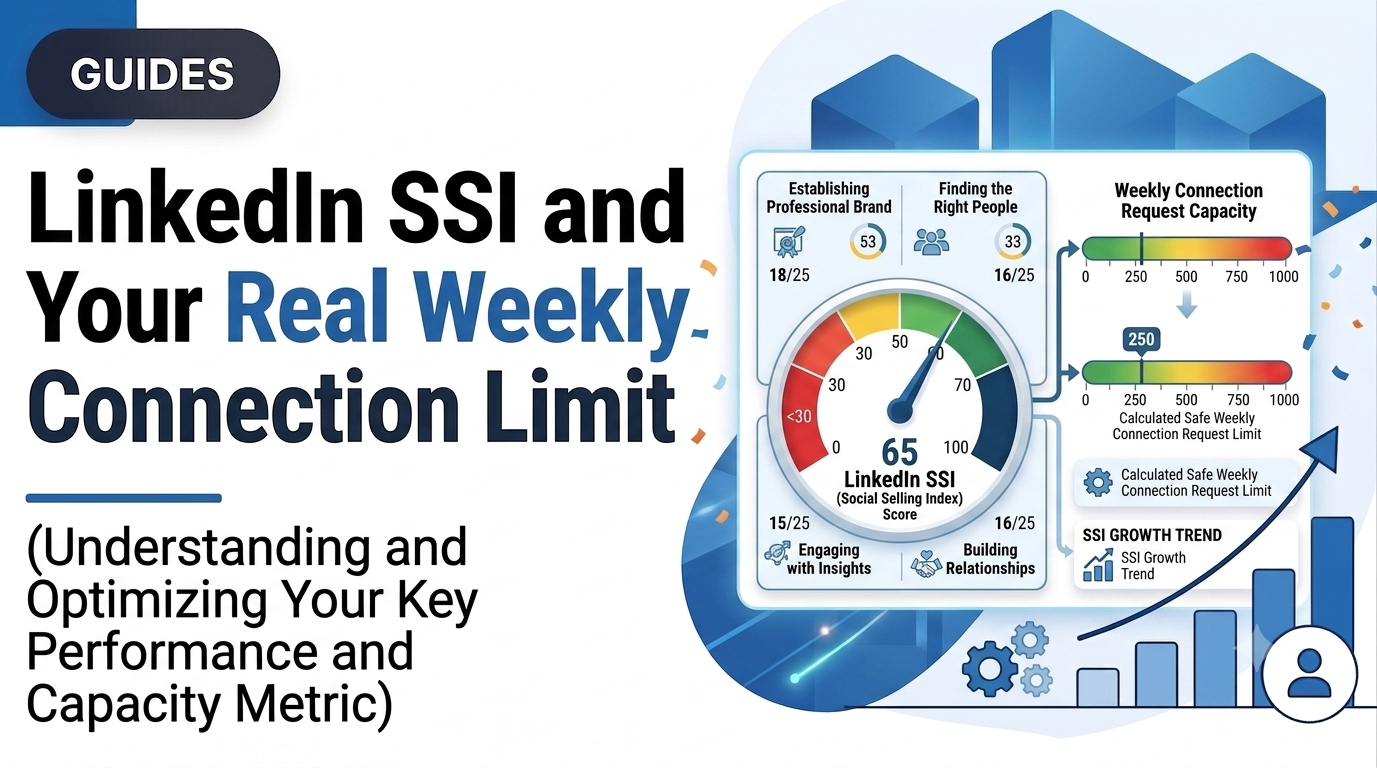
Social Selling Index, or SSI, is LinkedIn's own 0 to 100 score measuring how effectively an account is used for social selling, updated daily from your last 90 days of activity, and it is the primary reason two accounts on identical plans can have completely different real weekly connection limits. Most teams have never looked at their own SSI. Fewer still know it's connected to sending capacity at all.
We've covered before that LinkedIn's connection request cap sits around 100 a week regardless of plan tier. That's true as a baseline. What it leaves out is the variable that actually moves the number up or down, and SSI is that variable.
What SSI Actually Measures
SSI scores four pillars, each worth up to 25 points:
- Establishing your professional brand, a complete profile, consistent posting, credible presentation
- Finding the right people, using search and targeting effectively rather than broad, unfiltered outreach
- Engaging with insights, sharing and interacting with relevant content
- Building relationships, response rates and the strength of your actual network activity
The industry average sits around 35 to 50. A score above 70 to 75 puts an account in what LinkedIn treats as its top tier of social sellers. You can check your own score for free at linkedin.com/sales/ssi, and it updates daily, so it reflects a rolling window rather than a static snapshot.
The Part Most Guides Skip: SSI Moves Your Actual Ceiling
Here's the connection to sending volume. Multiple independent sources tracking LinkedIn's real-world limits report the same pattern: accounts with SSI in the 75-plus range are commonly observed reaching 150 to 200 connection requests a week, while the standard baseline sits around 100, and accounts that have been flagged or have weak engagement can drop to 20 to 30 a week even while staying technically within LinkedIn's terms.
That is not a minor variance. It's close to a 2x difference in raw sending capacity between a well-maintained account and an average one, and the deciding factor is a score you can check in thirty seconds and have never looked at.
Acceptance rate on connection requests is the most overlooked lever inside this. Sending volume without real targeting pulls SSI down even when the raw number of connections stays healthy, because the platform is reading acceptance and engagement quality, not just activity count. This is the same mechanism behind LinkedIn's account safety systems more broadly: they reward accounts that look like an engaged professional rather than an outreach engine, and SSI is effectively a visible proxy for that same underlying trust signal.
LinkedIn Is Quietly Downplaying the Metric It Still Enforces
Here's the part worth paying attention to. LinkedIn's own marketing has started de-emphasizing SSI in favor of Sales Navigator's newer AI-driven features, positioning tools like Lead Finder and Message Assist as the more relevant measure of sales effectiveness. Some coverage of this shift argues that chasing a high SSI score can distract from actually closing deals, since a high score doesn't always correlate with measurable sales outcomes on its own.
That argument is reasonable as far as it goes. What it doesn't change is that the score still exists, still updates daily, is still freely accessible, and still appears to correlate with the sending ceilings reported across independent tracking sources. LinkedIn deprioritizing SSI in its own product marketing is not the same as SSI stopping to function as a trust signal behind the scenes. Treat the score the way most experienced operators already do: not as a vanity number to chase for its own sake, but as the clearest free diagnostic available for why your sending capacity is what it is.
What Actually Moves the Score
None of the four pillars respond to a single action taken once. They respond to sustained, ordinary use of the platform:
- Complete the profile fully. Photo, banner, a real headline, a filled-out summary, and multiple experience entries. This is the fastest-moving pillar and the one most outreach-focused accounts neglect, because it doesn't feel like sales activity.
- Use targeted search rather than broad lists. The "finding the right people" pillar rewards precision, not volume, which lines up with the same logic that protects your connection acceptance rate.
- Engage with relevant content regularly. Even a few minutes a day commenting on posts from people in your target market moves this pillar, and it also does double duty as warm-up activity before you send a request.
- Reply to your own conversations. This pillar is about relationship-building activity, and it's the one most directly connected to actually running outreach well, since a healthy reply rate on your own account activity is part of what it measures.
Where This Fits Into Managing Multiple Accounts
If you're running outreach across several sender accounts, SSI is not a single number to track, it's a per-account health metric you need visibility into across your whole pool, because a low-SSI account is quietly capping your total send capacity even if its daily limit setting looks the same as a high-SSI account's.
This is exactly what per-account daily limits inside OutFlo's Multi-Account Campaigns are built to reflect. Rather than assuming every connected sender has the same real ceiling, limits are configured per account, and Smart Auto-Increase ramps each account's volume individually as it builds the kind of consistent, moderate activity history that SSI itself rewards. An account with low SSI and a fresh warm-up history should be running a smaller allocation than a mature, high-SSI account on the same team, and treating them identically is the fastest way to under-use your best accounts and over-extend your weakest ones.
FAQ
Common questions
What is a good LinkedIn SSI score?
The platform average sits around 35 to 50. A score above 70 is generally considered strong, and 75-plus is treated as top-tier social selling activity. Scores update daily based on your rolling last 90 days.
Does a higher SSI score actually increase my connection request limit?
Multiple independent trackers of LinkedIn's real-world limits report accounts with SSI 75-plus reaching 150 to 200 connection requests weekly, well above the roughly 100-a-week baseline most accounts see. This is not an officially published mechanic from LinkedIn, but it is consistently reported across sources tracking real account behavior.
Is Sales Navigator the same thing as a high SSI score?
No. Sales Navigator is a paid tier with additional search filters, lead recommendations, and AI features. SSI is a separate, free, activity-based score available to any account regardless of plan. A free account with strong engagement and profile completeness can outscore a Sales Navigator account with a thin, inactive profile.
Is LinkedIn getting rid of SSI?
LinkedIn's marketing has shifted toward promoting Sales Navigator's newer AI features over SSI, and some commentary argues the score distracts from actual sales outcomes. The score itself is still live, still updates daily, and remains freely accessible at linkedin.com/sales/ssi as of this writing.
How often should I check my SSI score?
Since it updates daily and reflects a rolling 90-day window, a weekly check is enough to catch meaningful movement. Treat it as a health check alongside your actual reply and acceptance rates, not a metric to obsess over daily.