In March 2026, LinkedIn removed HeyReach's company page and the personal LinkedIn profile of its founder, Nikola Velkovski, an enforcement action that appeared to target the vendor's public presence rather than an individual customer's outreach activity. LinkedIn has not publicly explained the reason behind the action, so any discussion of the underlying cause remains informed analysis rather than confirmed fact. Even so, the incident has prompted an important conversation across the outbound community: how much does automation architecture matter? For agencies and GTM teams building outbound programs on LinkedIn, that's the more valuable question to answer.
This Was Different From a Typical LinkedIn Restriction
Most LinkedIn enforcement happens at the account level. Accounts that suddenly increase activity, send excessive connection requests, or exhibit repetitive automated behavior may receive temporary restrictions before eventually recovering.
The HeyReach incident looked different. Rather than restricting individual customer accounts, LinkedIn removed the vendor's own company page and founder profile while customer automations reportedly continued running. Although LinkedIn hasn't confirmed what triggered the action, many observers viewed it as evidence that automation vendors themselves are receiving increased scrutiny, not just the users of those tools.
That distinction matters because it suggests the conversation is expanding beyond outreach volume alone, toward the infrastructure supporting automation platforms.
What Industry Discussions Suggest, and What They Don't
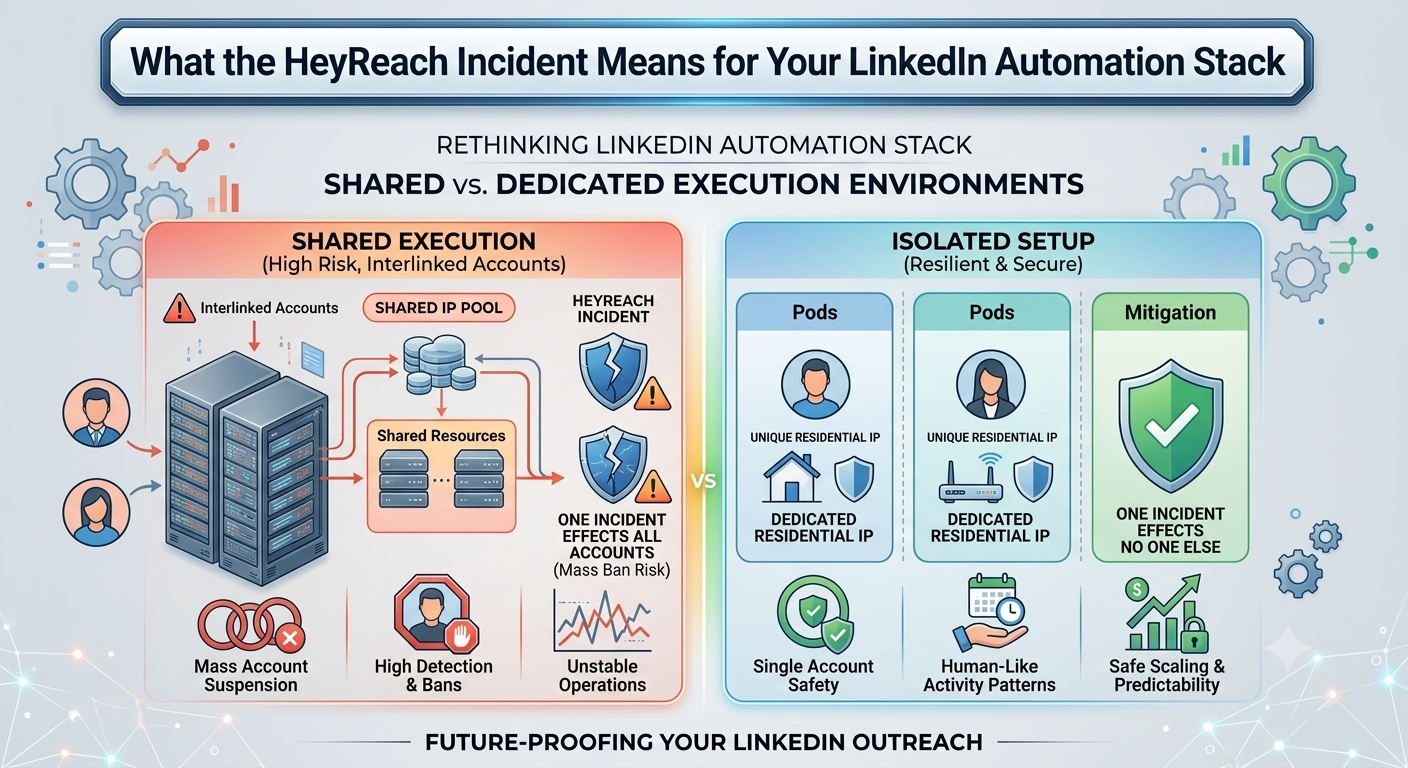
Several independent analyses following the incident discussed the role of shared cloud infrastructure as one possible explanation. The theory is straightforward: if many customer accounts operate through shared infrastructure, LinkedIn may be able to identify patterns that extend beyond any single account's behavior.
Note: it's important to separate this from a common misconception. This is not about browser-based automation versus cloud-based automation. There is no public evidence that simply running automation in the cloud makes a platform inherently riskier, and there is no evidence that browser-based automation is automatically safer. The discussion has instead focused on whether multiple unrelated customer accounts share common infrastructure in ways that could create detectable patterns.
Because LinkedIn has never confirmed the reason for its action, this should be viewed as one plausible interpretation rather than an established fact.
The Architecture Questions Worth Asking
Regardless of what specifically triggered the HeyReach incident, the conversation highlights two practical areas every buyer should evaluate when choosing a LinkedIn automation platform.
1\. Does every LinkedIn account receive its own dedicated residential IP?
One recommendation that consistently appears across infrastructure and automation best practices is avoiding shared execution environments wherever possible. Ideally, every connected LinkedIn account should operate through its own dedicated residential IP address that closely matches the geographic location where that account normally signs in. This reduces unnecessary infrastructure overlap between unrelated customer accounts while maintaining a more consistent login profile.
Whether a platform is cloud-based or browser-based matters less than whether accounts are isolated from one another.
2\. Is the platform designed to discourage spam-like behavior?
Infrastructure alone isn't enough. Even a perfectly isolated account can attract attention if it behaves unnaturally. Responsible automation platforms should include safeguards such as:
- Gradual account warm-up
- Configurable daily activity limits
- Randomized pacing
- Natural delays between actions
- Campaign controls that discourage excessive volume
No technical safeguard can eliminate enforcement risk entirely, but reducing repetitive, high-volume behavior remains one of the most practical ways to operate responsibly.
The Bigger Trend
Independent of any single vendor, many agencies and outbound teams have reported experiencing more frequent account disconnections and authentication issues over recent months. While these reports are anecdotal rather than official platform announcements, they align with a broader perception across the industry that LinkedIn has become increasingly proactive in monitoring automation.
That doesn't necessarily mean customer accounts using any particular platform are at immediate risk. It does suggest that agencies whose outbound operations rely entirely on one platform should think carefully about concentration risk. Just as revenue teams diversify acquisition channels, it may be worth avoiding a situation where every outbound workflow depends on a single automation provider or platform.
How to Evaluate Your Current Stack
Before selecting or renewing an automation platform, consider asking these questions:
- Does each LinkedIn account receive its own dedicated residential IP, or are infrastructure resources shared across multiple customers?
- Are IP locations aligned with where the LinkedIn account normally signs in?
- Does the platform enforce sensible activity limits and gradual account warm-up?
- Does it encourage responsible automation practices instead of maximizing sending volume?
- Is the vendor transparent about how its infrastructure is designed?
These questions are becoming increasingly important regardless of which automation platform you choose.
Where OutFlo Fits
OutFlo is designed around account-level isolation and responsible automation practices. Features such as per-account activity controls, campaign-level quota allocation, and Smart Auto-Increase help distribute outreach gradually instead of assuming full sending capacity from day one. Rather than encouraging maximum activity, these controls are intended to support sustainable outbound programs that avoid repetitive patterns commonly associated with aggressive automation.
When evaluating any platform, including OutFlo, we believe buyers should ask the same questions discussed throughout this article: how are accounts isolated, how is activity paced, and what safeguards exist to discourage spam-like behavior? Those questions matter more than whether a platform happens to execute automation from a browser or the cloud.
Final Thoughts
The HeyReach incident doesn't provide definitive answers about LinkedIn's enforcement systems. What it does provide is a reminder that automation architecture deserves more attention than it has traditionally received.
Whether you're evaluating a new platform or reviewing an existing stack, it's worth looking beyond feature lists and asking how the product is built, how accounts are isolated, and how the platform encourages responsible automation. As LinkedIn continues evolving its enforcement approach, thoughtful infrastructure and disciplined automation practices are likely to matter just as much as the messages you send.
FAQ
Common questions
What exactly happened to HeyReach in March 2026?
In March 2026, LinkedIn removed HeyReach's company page, which had approximately 16,400 followers, along with the personal LinkedIn profile of founder Nikola Velkovski. LinkedIn has not publicly explained the reason for the enforcement, so the exact cause remains unknown. The incident has since sparked widespread discussion about how LinkedIn evaluates automation vendors and their underlying infrastructure.
Did HeyReach customers have their LinkedIn accounts banned?
There is no public evidence of a widespread ban affecting HeyReach customers. According to HeyReach's own public statement, customer automations continued running after the company page was removed. The enforcement appeared to target the vendor's public presence rather than resulting in a mass restriction of customer accounts.
Was LinkedIn targeting cloud-based automation?
There is no public evidence that LinkedIn was targeting cloud-based automation as a category. Industry discussions following the incident have focused on infrastructure design, particularly whether multiple customer accounts share common execution infrastructure or IP resources. However, LinkedIn has not confirmed whether this played any role in the enforcement, so it should be viewed as an industry hypothesis rather than an established fact.
Does browser-based automation make an account safer?
Not necessarily. There is no public evidence that browser-based automation is inherently safer than cloud-based automation. The more relevant considerations are how the platform is built, whether customer accounts are properly isolated from one another, and whether the tool encourages responsible activity patterns instead of high-volume automation.
What should I look for when evaluating a LinkedIn automation platform?
While no provider can guarantee immunity from LinkedIn enforcement, there are several good questions to ask: does each LinkedIn account receive its own dedicated residential IP, is that IP geographically consistent with where the account normally signs in, does the platform include gradual account warm-up and realistic daily activity limits, does it discourage spam-like behavior through pacing and campaign safeguards, and is the vendor transparent about how its infrastructure is designed? These factors are widely considered good automation practices regardless of which platform you choose.